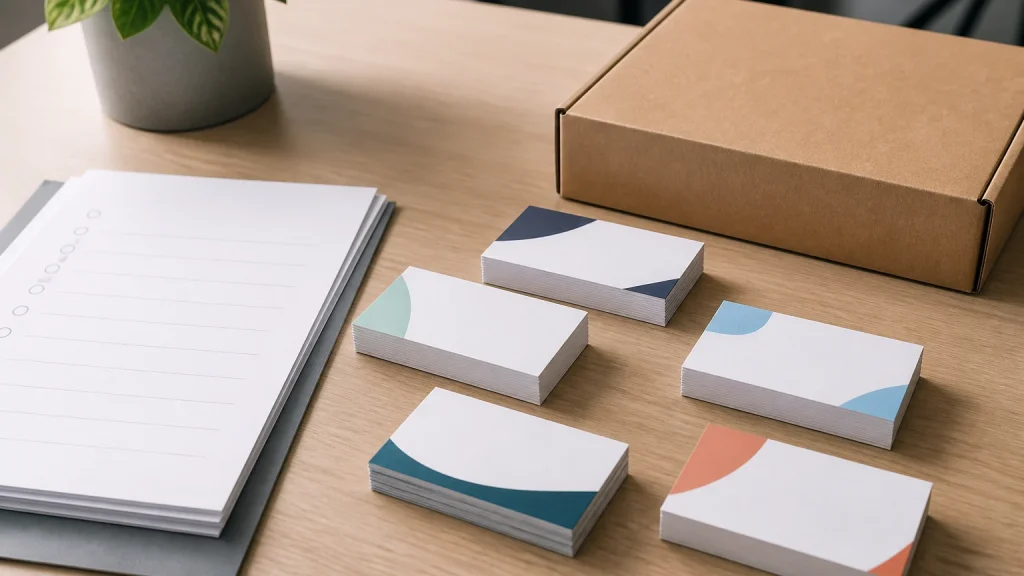
Business card printing UK for new starter packs works best when you treat cards as a controlled part of onboarding, rather than a one-off order for each employee. Create an approved template, decide which details may change, and set a sensible ordering process before the team grows. That keeps every card recognisably on-brand while allowing names, roles, phone numbers and locations to be updated when needed.
⏱️ Estimated reading time: 6 minutes
Table of Contents
Why business card printing UK needs a starter-pack plan

New starters often need practical materials: an email signature, access to company systems, perhaps a welcome pack, and sometimes business cards. Cards are particularly useful for client-facing roles, trade visits, events, property viewings or local networking.
The difficulty is not usually the card itself. It is maintaining consistency when people join at different times, work in different departments or use slightly different job titles. A card ordered from an old file may carry a previous logo, former address, retired web address or an inconsistent typeface.
A starter-pack approach separates the permanent parts of the design from the variable ones. Your logo, brand colours, core contact route and layout rules remain fixed. The employee name, role and direct details sit in clearly defined areas. That gives whoever orders the print a straightforward brief and reduces the chance of unnecessary redesign each time someone joins.
It is also worth deciding which employees genuinely need cards. Ordering cards because they have always been included in a pack can create avoidable waste and outdated stock.
Build one card template before the first order
Start with a master artwork file that has been approved by the people responsible for the brand. It should show the intended card orientation, logo position, colours, type hierarchy and the information that belongs on every card. Keep an editable version under version control, rather than relying on a flattened PDF as the only record.
Agree a short data checklist for every new starter. In most cases, that will include the person’s preferred name, job title, email address, direct number where applicable, company website and any approved social or booking detail. Check spelling against the employee’s own confirmation. Names and email addresses are easy to mistype, and a proof is far less useful if the details have not been checked by the right person.
Keep the front and reverse purposeful. One side might carry the person’s contact details, while the other may contain a restrained brand message, service list or visual element. Trying to list every service, office detail and social platform can make a small format feel crowded. If a recipient cannot quickly find the name and preferred contact method, the card is doing too much.
Ask the printer what artwork format, bleed and safe-area guidance applies to the chosen product before finalising the master file. These requirements can vary between products and suppliers. Important text should not sit close to the trimmed edge, and any background intended to run to the edge needs artwork prepared for that purpose.
Choose quantities and a reprint method for new starters
The right quantity depends on how often a person hands out cards, how settled their contact details are and whether recruitment is frequent. A new account manager attending meetings every week may use cards differently from a colleague who only occasionally visits an event. A modest initial quantity can be a sensible safeguard while a new role, telephone number or title is still bedding in.
Digital printing may be worth discussing for small batches or regular updates because it can accommodate changing personal details without treating every card as a large shared run. Litho printing may be considered where the design is stable and the overall quantity is much larger. Neither route is automatically the better choice; the useful comparison is between the quantity, the level of personalisation and how likely the information is to change.
| Ordering approach | May suit | Watch for |
|---|---|---|
| Small individual batches | Occasional hires or changing roles | Repeated proofing and less consistent ordering |
| Scheduled grouped order | Several confirmed starters | Holding cards for people whose details may change |
| Central stock process | Teams with regular recruitment | Using an outdated master artwork file |
A simple central record helps. Note the approved template version, employee details, quantity, order date and the person who signed off the proof.
For a hypothetical growing consultancy, three confirmed starters could be grouped into one artwork check while retaining individual names and roles. A fourth person whose title is still under discussion might wait until that detail is agreed.
Common mistakes in business card printing UK for teams

The most common mistake is treating a previous employee’s card as the template. It may appear quicker to swap a name, yet it can preserve old wording, a former role structure or incorrect details.
Another issue is too many decision-makers changing the artwork separately. Give one person or small team responsibility for the master design, and make clear who can approve a new variation. A sales team might need a role-specific line, for example, while the core layout remains unchanged. Without that boundary, cards tend to drift over time.
Do not assume a digital contact prompt removes the need for readable printed details. If you include a QR code, test it at the final intended size and leave it enough clear space to scan. It should support the card, not become an excuse for tiny type or missing contact information. The destination also needs ongoing ownership; a code pointing to a temporary campaign page may not serve a new starter for long.
Finally, avoid ordering far ahead for unconfirmed recruits, office moves or planned rebrands. Cards are personal and time-sensitive. When the business is in transition, a smaller order and a clear reprint process may be more sensible than a large quantity based on assumptions.
Conclusion
A well-run starter-card process gives new team members a useful branded tool without creating a trail of obsolete stock. Use one approved template, collect details through a repeatable checklist, match quantities to likely use and keep a record of each version. If the design, data or quantity is unusual, set out those requirements clearly when requesting a print quote so the proposed solution can reflect the actual onboarding plan.