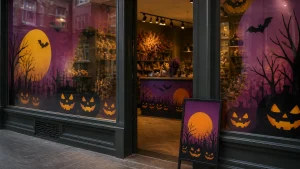
custom Halloween banners can give sponsors worthwhile recognition without pushing your event name, offer or visitor action into the background. The most reliable approach is to decide the banner’s single job first, reserve a clearly defined sponsor area, then build the main message around how people will actually see it.
⏱️ Estimated reading time: 6 minutes
Table of Contents
Give custom Halloween banners one main message

Start with the question a passer-by needs answered in a few seconds. For a retail banner, that may be a seasonal offer. For an attraction, it might be the name of the event and where to enter. A venue could need to highlight a booking prompt, while a community event may need to make its date and location clear.
Write that answer before collecting logos, graphics and decorative Halloween elements. It becomes the banner’s lead message. Everything else has a supporting role.
A three-level structure helps:
- Primary: the event, offer or action you want people to notice first.
- Secondary: useful details, such as a date, location or short supporting line.
- Supporting: sponsor logos, organiser branding and partner information.
Choose the right banner role before sharing space
Trying to make one banner announce an event, direct visitors, list attractions and acknowledge every sponsor is usually where the layout starts to struggle. Separating those jobs can make sponsor space easier to manage and gives each display a clearer purpose.
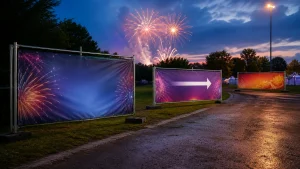
For example, a hypothetical Halloween trail could use an entrance banner for the attraction name and key arrival message, with a separate welcome board carrying fuller organiser and partner recognition. A shop may use a window banner for one offer, then place sponsor or supplier information on a smaller counter display if it is genuinely needed there.
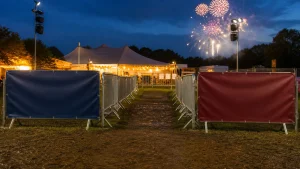
Placement matters too. A banner near an entrance may need stronger event branding, while a display beside a stage, activity area or collection point may reasonably give partners more visual presence. Think about its location before deciding which details deserve space.
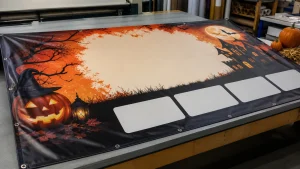
Build custom Halloween banners around a clear sponsor zone
It could sit along the bottom edge, down one side, or in a separate panel.
A dedicated sponsor zone also makes approval simpler, since everyone can see the space allocated before artwork is finalised.
Keep sponsor logos together and apply a consistent rule for their size, spacing and background. Different logo shapes can make one partner appear dominant by accident. A long horizontal logo, for instance, may need a different-sized holding area from a square mark to look balanced. The aim is equal visual consideration where that is appropriate, not necessarily identical measurements.
Leave clear space around each logo. Crowding logos against Halloween illustrations, borders or the banner edge can make the whole sponsor area look unplanned. A calm background also tends to help brand marks remain recognisable. If several sponsor colours clash with the campaign palette, a neutral panel may be a sensible compromise.
Ask sponsors for their current approved logo files rather than copying marks from websites, social posts or old printed material. Confirm whether a particular logo version, strapline, colour treatment or acknowledgement wording is required. That small check can prevent a late artwork change.
Common mistakes when sponsor logos meet seasonal artwork

The common mistake is treating empty space as wasted space. Seasonal artwork can be fun and theatrical, but extra bats, cobwebs, pumpkins and type styles do not always make a banner more effective. Once the event message and sponsor area are agreed, decorative elements should frame the content rather than fill every gap.
Another problem is giving each sponsor a separate visual treatment. Mixed panels, outlines, backgrounds and logo sizes can make partners look unequal and turn the footer into a patchwork. One restrained sponsor treatment is generally easier to maintain if a logo changes or another partner is added.
Do not rely on a screen-sized artwork review alone. Zooming out may show whether the lead message still dominates, but it cannot fully replicate how a banner will be encountered in its intended setting. Review the proof for spelling, contact details, logo versions, cropped edges and the relationship between the main message and sponsor area. If the display will be viewed from a distance, ask whether every line is necessary.
There are occasions when a sponsor-heavy banner simply does not make sense. If recognition requirements leave too little room for a readable event message, consider a second display, a larger format or a different placement strategy. A banner carrying only sponsor recognition may work at a suitable partner area; it is less useful as the main invitation to a Halloween event.
Brief the banner printer with the right information
A clearer brief reduces avoidable questions and helps the artwork process start in the right direction. Include the finished banner size, where it will be displayed, the main message, any fixed wording, the sponsor list, logo files and your preferred deadline. If the banner needs particular fixing or finishing options, mention that too, as suitability depends on the display plan.
It is also worth naming one person who can consolidate sponsor feedback. Multiple uncoordinated approvals can create conflicting requests, especially when partners are reviewing their own logos rather than the whole layout. Give reviewers a specific deadline and make clear that approval covers the complete banner, not just an individual logo.
Newstyle Print produces wide-format printed displays, including PVC banners, and can help with bespoke print work and design support where required. For a sponsor-led Halloween banner, sharing the complete brief at the outset gives the design and print team the best chance of recommending a practical route.
Conclusion
A well-planned Halloween banner gives the main event or offer first claim on attention, then recognises sponsors in a consistent, deliberate area. Decide the banner’s job, set the message hierarchy, collect approved logo files and review the whole artwork before it goes to print. If sponsor requirements are too extensive for one clear display, split the communication rather than forcing every detail onto a single banner. That approach keeps the finished piece more useful for visitors and fairer to the partners supporting it.