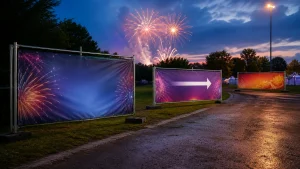
Bonfire night banners can help visitors move confidently between a venue’s separate areas when every banner has one clear navigational job. Map the journey from arrival to exit: where people pause, which choice they need to make, and what they should look for next. This approach is particularly useful where a fireworks display, food stalls, parking, family activities and viewing spaces are spread across one site.
⏱️ Estimated reading time: 6 minutes
Table of Contents
Map visitor decisions before ordering bonfire night banners

Start with a simple site plan, even if it is only a marked-up aerial image. Trace the route a first-time visitor is likely to take from each entrance. Mark every point where they might ask a volunteer, stop walking, or follow the crowd without really knowing where it is going. Those are the places where a banner may earn its space.
Plan by zones, such as the entrance, ticket point, food area, viewing field, activities, toilets, first aid and exit. Use short visitor-facing names consistently in programmes, announcements, staff directions and banners.
A useful planning rule is that a banner should answer one immediate question: “Where am I?”, “Which way is the viewing area?” or “Is this the queue for food?” Trying to answer all three at once tends to create a crowded display. Essential safety instructions and any official notices should remain separate from promotional or wayfinding artwork, with their placement agreed through the event’s own planning process.
Give each route a clear visual identity
Visitors should not have to read a paragraph to follow a route. Use a consistent label, colour treatment and simple directional device for each major area, then repeat that combination at the next decision point. For example, an organiser might use a warm orange panel for food, a dark blue panel for the viewing area and a bright green panel for family activities. The colours are not instructions in themselves; the written zone name still does the real work.
Make the destination largest, add an arrow where it clarifies the direction, and include secondary details only when they help a choice. Keep logos, sponsors and firework graphics secondary to the message.
Where several banners belong to the same route, create one artwork system rather than designing each piece in isolation. Matching typefaces, icon style and colour blocks make the route feel joined up. It also makes late checks easier: the organiser can compare wording across the full set and spot an old zone name or conflicting arrow before print approval.
Place bonfire night banners where visitors approach each area
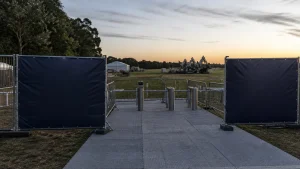
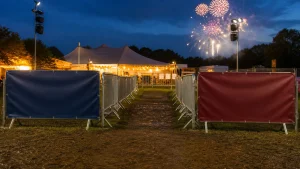
Choose locations for the way people approach them, considering queues, structures, lighting and whether visitors walk or wait. Use one banner to introduce a destination and another at a turn to confirm it; junctions need an unobstructed view before the decision.
It may help to walk the venue in the same direction as visitors, ideally with the site plan in hand. Stand where a family arriving from the car park would stand, then check what competes for attention: stall fronts, fencing, parked vehicles, other signs or a busy crowd. A neat design can be ineffective if it is hidden behind a queue or positioned after the turning point.
For a hypothetical school-field event, the arrival banner might simply identify the entrance. Beyond ticket checking, a larger route banner could split traffic between “Viewing Area”, “Food Village” and “Activities”. Near the activities, a smaller confirming banner reassures visitors that they have reached the right place. Each item has a different job, even though the visual style remains consistent.
What to include in a practical banner brief

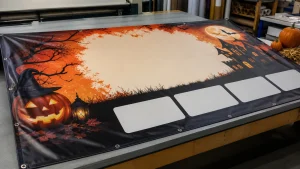
A clear brief should state the proposed size, quantity, location, orientation, artwork status and required finishing or fixing details. If format is uncertain, describe the display space and support rather than guessing.
Supply final, approved wording in a single document. Include exact zone names, arrows, contact details where genuinely needed, sponsor artwork and any brand rules. It is sensible to nominate one person to collect amendments, because separately emailed edits can easily produce mixed versions. Ask everyone involved in the event to check names, dates, times and directional wording before the artwork is signed off.
Newstyle Print offers PVC banners and bespoke wide-format print work, alongside graphic design support where artwork needs creating or amending. A useful quote enquiry explains the event layout and the role of each banner, not only the dimensions. That gives the team context to discuss the printed display rather than treating every location as identical.
Avoid using bonfire night banners for every message
The common mistake is designing one oversized banner that attempts to welcome visitors, advertise attractions, display a timetable, thank sponsors and point to several zones. It may contain all the information, yet still leave people unsure what to do next. Splitting the content by location is usually clearer: a welcome message belongs at arrival, a directional message belongs at a junction, and a programme belongs where people have time to stop and read.
This does not mean every event needs a large number of banners. A compact site with one obvious route may only need a few carefully placed displays. Equally, a complicated venue may benefit from banners supported by posters, A-frames or other signage formats. The sensible choice depends on the site, the message and the way visitors are expected to move.
Banner-led wayfinding also does not make sense when details are still changing. If a zone, timetable or route has not been confirmed, leave it off the banner or use a more flexible supporting format for that information. Printed route banners work best for details that are stable enough to remain useful throughout the event.
Conclusion
Well-planned bonfire night banners do more than add seasonal colour: they give visitors a clear next step as they move between zones. Map the site, name each area consistently, give every display one purpose and check placements from the visitor’s viewpoint. When the layout or artwork is unusual, prepare a concise brief and request a bespoke print quote so the banner format, design and message can be considered together.