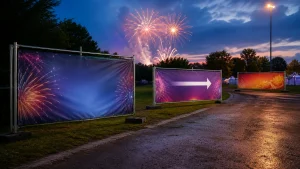
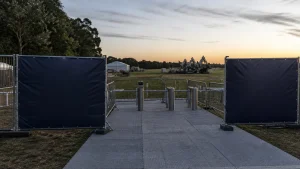
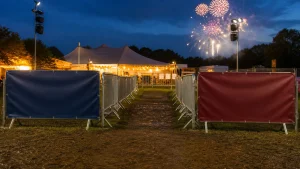
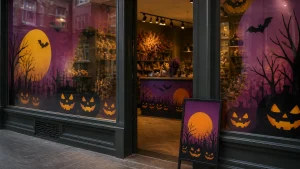
Bonfire night signage can clarify temporary safety routes when each display has one job: directing visitors away from a hazard, towards a facility or through a changing part of the site. Start with the routes people are expected to use, then write short messages for each decision point. Decorative event graphics may still have a place, but they should not compete with operational instructions. The organiser and the people responsible for the event plan should approve final wording, locations and any site-specific requirements before signs are produced.
⏱️ Estimated reading time: 6 minutes
Table of Contents
Map Bonfire night signage around real decisions

Visitors do not experience an event site as a neat plan on paper. They arrive in groups, follow the crowd, stop at barriers and make quick choices. A useful plan follows that journey: approach, entrance, ticket check, facilities, viewing area, food area, exit and onward route.
Mark places where someone may hesitate or take the wrong direction. These can include a split between pedestrian and vehicle access, a closed path, the edge of a restricted area, a queue that changes direction or an exit route used after the display. Each location needs a clear instruction rather than a broad statement about safety.
For instance, a sign at a path closure might read, “Pedestrian route closed – follow exit signs”, with a directional arrow. A board placed some distance away saying “Please stay safe” may be well meant, but it does not resolve the immediate choice.
A simple route map shared by the event team can help prevent gaps. Number each sign location, note its purpose and record the direction from which it will be read. It also gives volunteers a reference if they need to repeat the same instruction verbally.
Separate essential instructions from event promotion
Bonfire Night can involve several messages at once: a welcome, programme details, food offers, toilets, first aid, exits and restricted areas. Trying to fit them all onto one board usually makes the most important message harder to spot.
Give route and safety information its own space, consistent wording and a recognisable layout. Promotional boards can then sit where visitors have time to read them, such as near a refreshment area or an entrance queue. This separation is especially useful when routes change during the event.
Use plain verbs for temporary directions: “Enter”, “Queue here”, “Keep left”, “Exit”, “No access” and “Follow arrows”. Seasonal wording may suit welcome signage, but it is best kept away from movement instructions.
Choose formats that suit each temporary location
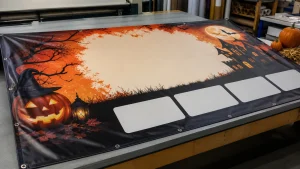
The suitable format depends on where the message will be seen, how long it is required and how the site intends to display it. Newstyle Print offers wide-format products including PVC banners, Foamex boards, Correx boards, Dibond boards, A-frames, roller banners and custom-cut signs.
| Signage need | Possible format | Planning point |
|---|---|---|
| Entrance or boundary message | Banner or board | Leave room for a short headline and a clear direction. |
| Moveable queue instruction | A-frame or freestanding display | Check that it will not obstruct the route it explains. |
| Fixed temporary direction | Board or self-adhesive vinyl | Confirm the available surface and later removal arrangements. |
| Information point | Poster or roller banner | Use for details people can pause to read. |
Do not choose a format only because it is the largest. A smaller sign directly at a turning point may be more useful than a large display passed before visitors need the information.
Bonfire night signage needs visual hierarchy
Every display should answer one immediate question before adding anything else: what must the reader do? Put that instruction first, make it visually prominent and keep supporting detail secondary. A telephone number, event branding or explanatory note should not take priority over a direction.
Contrast matters, particularly where an event may continue into low light. Dark backgrounds, colourful firework artwork and small type can create an attractive design while reducing clarity. Review the proposed sign at a realistic viewing distance, and consider whether the message can be understood quickly.
Where the same instruction appears in several places, use identical wording. Switching between “way out”, “exit route” and “leave here” can make a temporary route seem less certain. Consistency also helps staff identify an outdated sign if the plan changes.
Settle routes before printing Bonfire night signage

A common mistake is treating signage as the final decorative task, then sending artwork to print before barriers, access points and steward positions have been confirmed. That can leave an organiser with a polished sign pointing towards a route that has changed.
Divide information into fixed and flexible content. Fixed content may include the event name, site entrance or toilets. Flexible content may include queue directions, parking arrangements, gate status and temporary closures. Keeping flexible messages on separate signs can mean a late change affects fewer displays.
As a hypothetical example, a venue may open a second pedestrian exit after a queue builds. A separate directional board can be amended without changing the welcome sign, food-area display or programme board. That is often easier to manage than asking one all-purpose sign to cover every possible instruction.
Prepare a practical print brief
A useful brief gives the printer enough information to advise on the display, rather than simply receiving a file. Include the intended size, quantity, artwork status, location, whether the message is fixed or likely to change, and any finishing or fixing details that are relevant. Supply approved wording separately as well as within the artwork.
If design support is needed to turn a route plan into print-ready signs, Newstyle Print can assist with bespoke print work and design. A clear brief remains valuable because it reduces the chance of a strong layout being built around an unconfirmed instruction. Check proofs carefully for arrows, wording, dates, contact details and version labels before approval.
Conclusion
Effective Bonfire Night signage is practical before it is decorative. Map the visitor journey, give each display one purpose, separate operational directions from promotion and keep changeable information easy to replace. Once the route plan and wording are approved by the responsible event team, prepare a print brief covering locations, quantities, formats and artwork. For an unusual site layout, confirm the most suitable signage approach with the printer and event team.