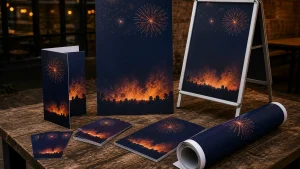
Bonfire night printing works best when every item is built from one approved set of event details. Rather than designing flyers, posters, menus and signage separately, start with a master message containing the date, venue, opening information, ticket route, key visitor notes and contact details. You can then adapt that content for each printed format while keeping the wording, branding and practical information aligned. It is a simple discipline, but it can prevent confusing differences between materials seen before and during an event.
⏱️ Estimated reading time: 6 minutes
Table of Contents
Start bonfire night printing with one master message
Before choosing paper, boards or wide-format displays, agree the information that must appear consistently. Keep it in a shared document, with one person responsible for approving amendments. For an organised Bonfire Night event, this might include the event name, date, location, start information, admission arrangements, booking details and an event contact.
Separate fixed information from details that are still being decided. A venue name and event date may be safe to print early; a final running order, parking arrangement or food offer may not be. If a detail could change, consider whether it belongs on a smaller, later print run or a temporary display instead of a high-quantity promotional item.
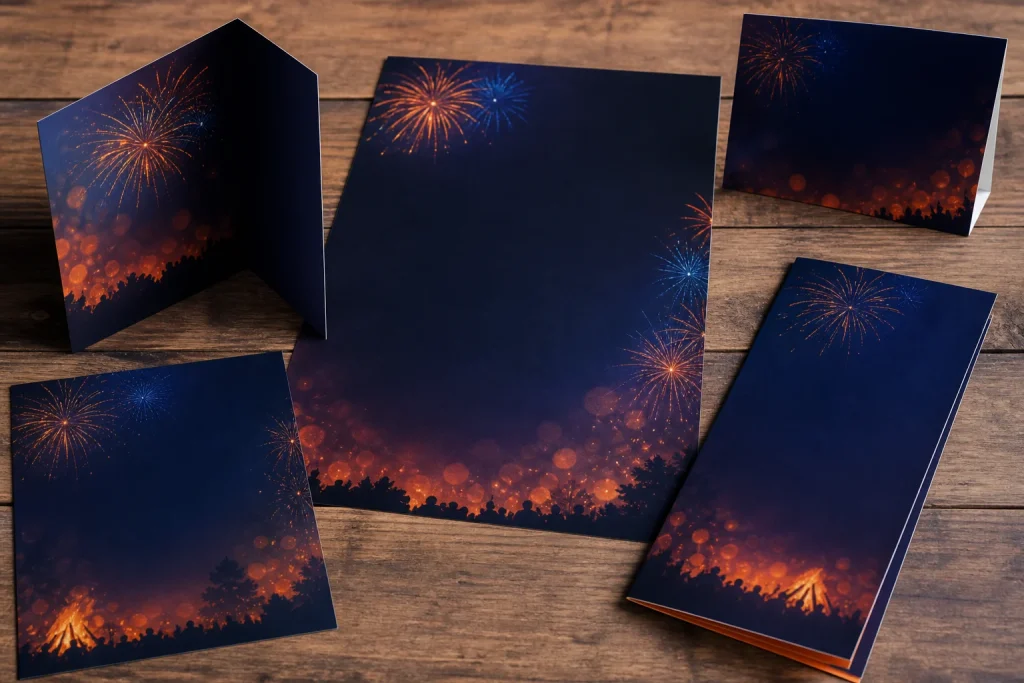
Give every line a priority. The event name and date should be immediately clear. Booking information needs to be easy to find. Supporting copy, sponsor acknowledgement and decorative fireworks artwork come afterwards. This hierarchy gives designers room to create a lively seasonal look without allowing the essential facts to disappear.
Match each printed item to its job
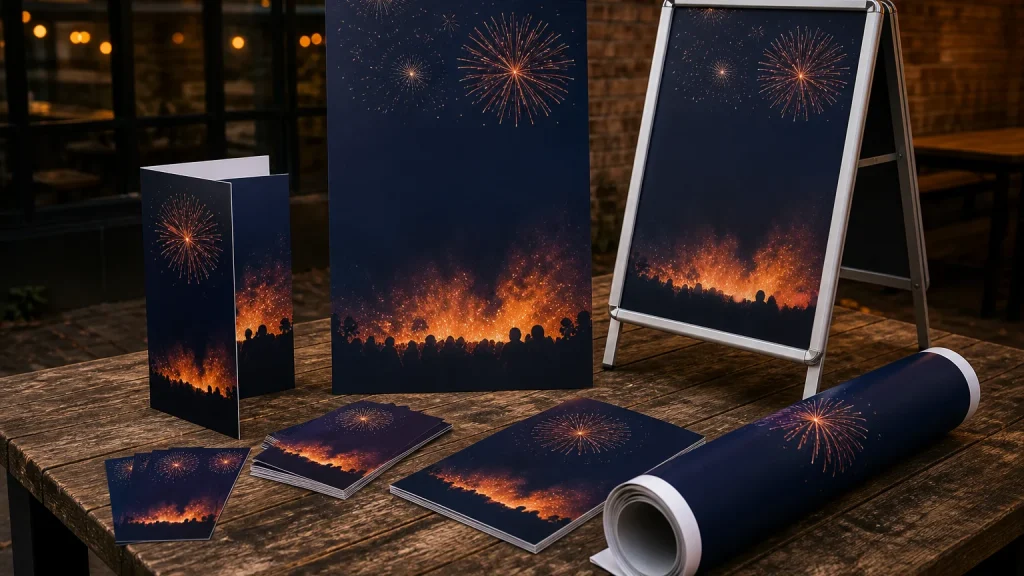
A coordinated campaign does not mean putting the same crowded layout on everything. Each item has a different viewing situation, and its content should reflect that. A flyer may need a concise reason to attend and a booking prompt, while a poster may need a bolder date and location. On-site signage is likely to work better when it deals with one immediate instruction or destination.
| Printed item | Best use in the set | Information to prioritise |
|---|---|---|
| Flyer or folded leaflet | Advance promotion and take-away details | Event offer, date, venue and booking route |
| Poster | Promoting the event in local display spaces | Event name, date, location and short callout |
| Menu or price list | Communicating a venue’s seasonal food and drink offer | Items, prices and any relevant ordering details |
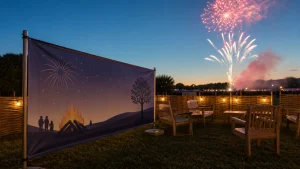
| Banner, board or A-frame | Identifying an area or reinforcing the event identity | A short message visible at a glance |
Use the same logo, colour palette, typefaces and approved event name across the set. Repeating those elements is usually more useful than repeating every sentence. A flyer can carry fuller detail; a large display needs restraint. If visitors have to stand close to a banner to understand it, the design is probably trying to do too much.
Choose a bonfire night printing route for the quantity
The quantity, deadline and number of versions all influence whether digital or litho printing may suit the job. Digital printing can be a practical route for smaller quantities, late additions or versions that change between venues. Litho printing may be worth discussing for a larger run of the same finished artwork. The right choice depends on the full specification, rather than the product name alone.
Wide-format printing suits the bigger pieces of the campaign, such as PVC banners, posters, printed boards, roller banners and display graphics. Ask early where each item will be placed, how it will be fixed and whether it must be moved during the event. Those practical points affect format and finishing, so they should not be left until the artwork is complete.
A hypothetical venue might need a modest batch of flyers for advance promotion, a few posters for its own noticeboards and several short-message signs on the night. That is not necessarily one print order. Group items by their purpose, artwork status and quantity, then request advice or a quote on the combination. It may make approvals easier too.
Common mistake: treating every version as final
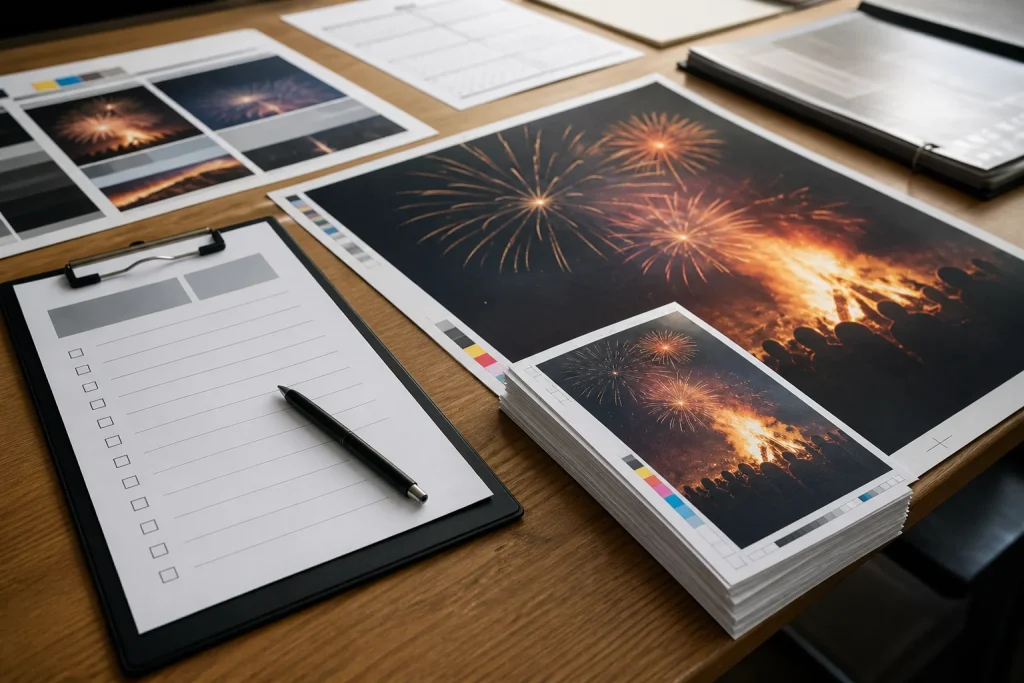
The most expensive-looking error is often an old detail that remains in circulation. A poster can be technically well printed and still cause trouble if it shows a replaced booking instruction, an earlier opening time or outdated contact information. Seasonal events tend to involve several contributors, which makes version control especially important.
Name artwork files clearly by item, revision and approval status. Avoid labels such as “final final” or “latest”, which quickly lose meaning once several files are being shared. Instead, use a consistent convention, for example event-name_item_r03_approved. Keep the approved copy beside the artwork so the person checking a proof can compare the two.
Proofreading should be a content check, not just a glance at colours and spelling. Confirm names, dates, locations, web addresses, telephone numbers, prices and QR codes where used. Check that small print remains readable at the intended finished size.
When bonfire night printing does not need a full set
Not every Bonfire Night promotion needs flyers, displays, menus and signage. A small retail offer may only require a window poster and a few counter cards. A hospitality venue with an established audience may instead need a seasonal menu and a limited number of table displays. Ordering a large matching suite simply because it looks comprehensive can create waste and leave you with outdated stock.
Start with the reader’s next action. Do they need to book, visit a venue, find a counter, choose from a menu or recognise a collection point? Choose the few formats that genuinely support that action.
If your event has unusual dimensions, multiple locations or artwork that needs adapting, a bespoke print brief is often more useful than trying to force every item into a standard template. Include the intended use, finished size, quantity, artwork status and any deadline when requesting a quote.
Conclusion
Effective Bonfire Night print is less about producing the maximum number of items and more about making each item agree. Build one master message, assign a clear job to every format and control changes before artwork is approved. Newstyle Print can produce digital, litho and wide-format materials, with design support available where artwork needs creating or refining. A clear brief gives you the strongest starting point for a coordinated seasonal print order.