The right banner size is the one that lets people recognise the message at the point where they first need it. For large vinyl banner printing, begin with the likely viewing distance, then work back through the message, display position and available fixing space. A banner does not need to carry every detail from a leaflet; outdoors, a larger, simpler message is usually easier to use than a smaller banner crowded with information.
⏱️ Estimated reading time: 6 minutes
Table of Contents
- Start with the real viewing position
- Match large vinyl banner printing to the message
- How large vinyl banner printing supports distance planning
- Use the site to choose proportions
- Common large vinyl banner printing mistakes that make banners feel smaller
- When a banner is not the right answer
- Conclusion
Start with the real viewing position
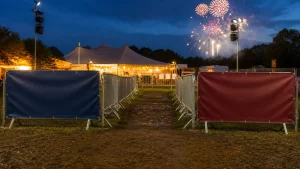
Before choosing dimensions, stand where the audience will be. Are people walking past on the same pavement, approaching from a car park, crossing a playground or viewing the banner from a road?
Also consider the approach angle. A banner mounted parallel to a path is viewed for longer than one facing across it. A banner above a gate may be visible from further away, but its lower details can be obscured by people, parked vehicles or landscaping. Taking a few photographs from the intended approach route is a practical way to assess these issues.
Match large vinyl banner printing to the message
Think of an outdoor banner as a hierarchy of information. The main line should be readable first, followed by a supporting detail only if the viewer has time to look again. A business name, event title, directional instruction or short offer may deserve the largest area. Contact details, dates and social media information should not displace that priority.
A useful planning exercise is to write the message in three levels:
- Must be seen: the main name, instruction or event message.
- Useful next: a date, location or brief supporting phrase.
- Optional: phone numbers, web addresses, sponsor marks or detailed terms.
If the first level cannot be read comfortably at the intended distance, increasing the banner size may help, but reducing the wording is often the more effective first move. A wide banner creates room for a strong horizontal message, while a taller format can suit a narrow gate or railing.
How large vinyl banner printing supports distance planning
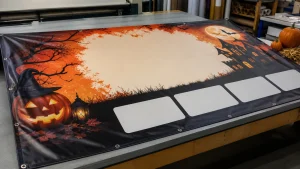
Large vinyl banner printing gives organisations the flexibility to specify a format around the display location rather than forcing a message into a fixed poster size. A long frontage may suit a horizontal banner, while a school entrance or event route may call for a portrait-oriented display. The most useful size is one that fits the available space with enough clear margin around the key wording.
For instance, a hypothetical community event might need a banner beside an entrance where visitors pass at close range. The organiser could prioritise the event name and an arrow, with the date in a second line. The same event advertised from the far side of a playing field would need a more stripped-back message and a noticeably larger visual presence.
Ask the printer about the finished dimensions, orientation and intended fixing method at quotation stage. These details affect how the banner is composed and where safe clear space should sit. Newstyle Print can provide an artwork check before print, which is an opportunity to flag files that appear difficult to read or that place important content too close to an edge.
Use the site to choose proportions
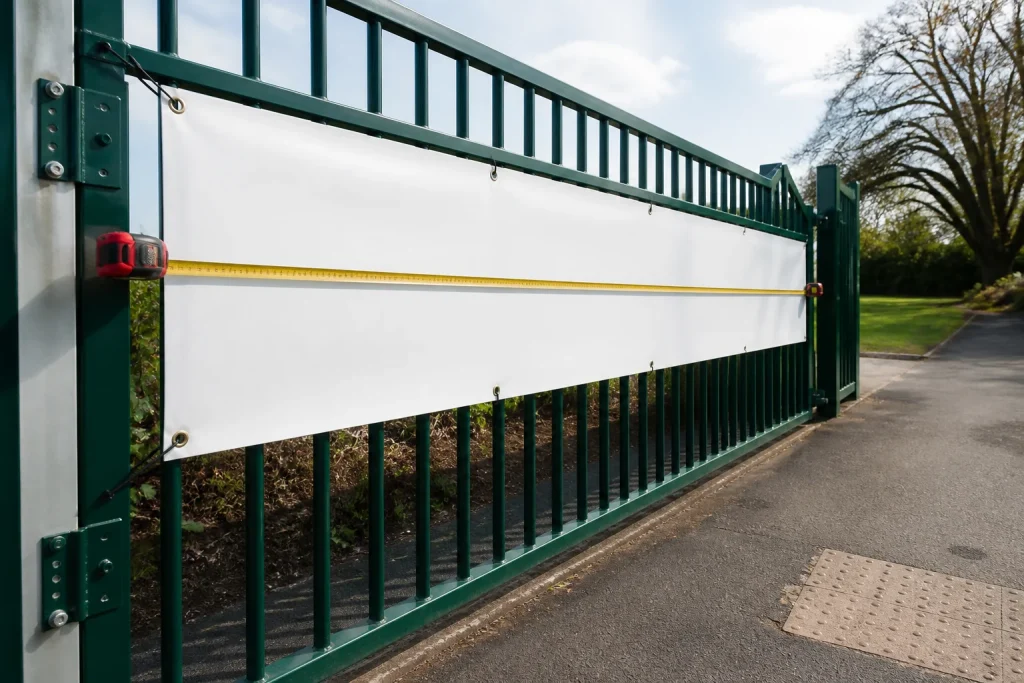
Measure the usable display area rather than estimating it. Include posts, rails, gates, windows and any gaps that may interrupt the design. Leave room around the banner so that fixings do not pull across a logo, letter or arrow. If a banner will be fitted between two points, record both the width and the height available, plus any obstructions nearby.
The following guide is not a universal sizing chart; it is a way to frame the brief.
| Display situation | What matters most | Useful design emphasis |
|---|---|---|
| Close pedestrian route | Time to read while moving | Clear headline and concise supporting details |
| Entrance, gate or reception approach | Available space and direction of travel | Event name, welcome message or directional cue |
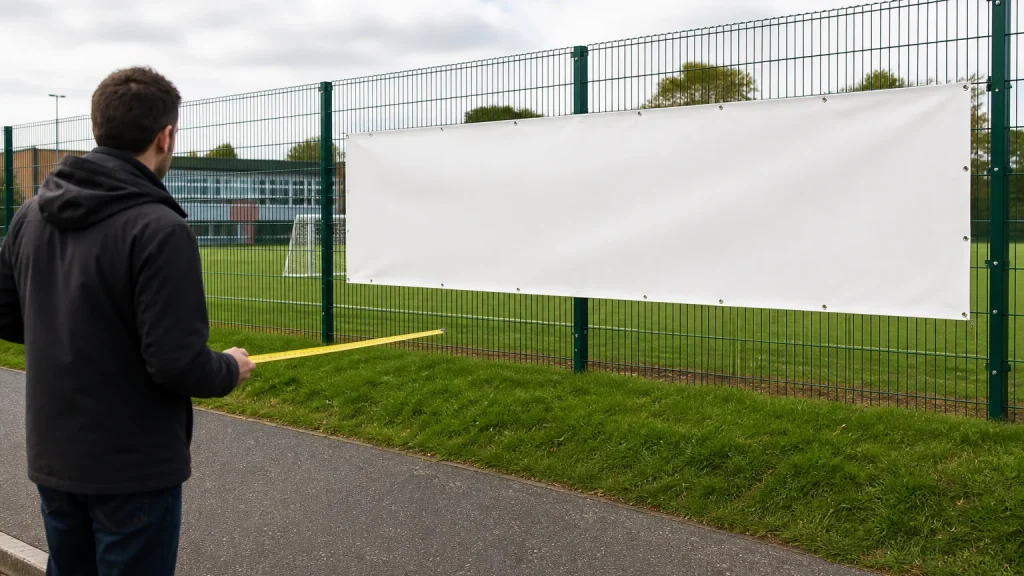
| Car park or sports field edge | Longer viewing distance | Fewer words, larger headline and stronger contrast |
| Busy roadside setting | Brief, angled views and surrounding clutter | One immediate message; avoid fine print |
Where the viewing distance varies, design for the farthest point at which the main message matters. People standing closer can still take in secondary details, but distant viewers cannot recover a headline that is too small.
Common large vinyl banner printing mistakes that make banners feel smaller
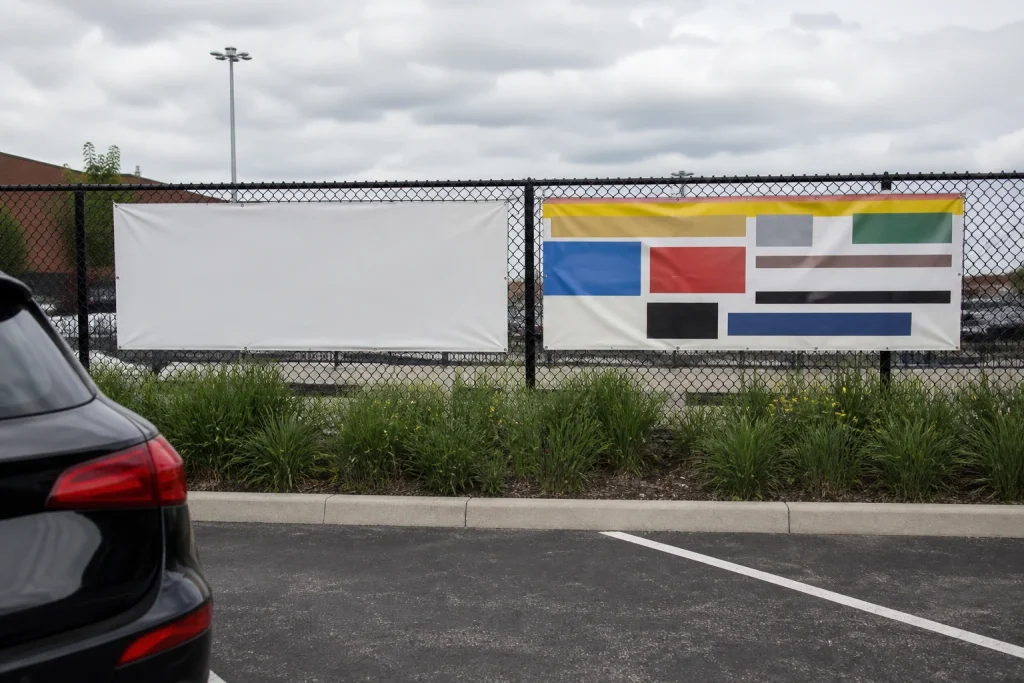
The most common mistake is treating a banner like a brochure. Long sentences, several competing calls to action, small logos and extensive contact information can make even a physically large banner hard to process. A viewer should not have to stop and decode it.
Contrast deserves attention too. A pale typeface over a detailed photograph may appear attractive up close yet lose clarity outdoors. Use a plain area behind essential text, avoid placing letters across busy edges, and do not make meaning depend on colour alone. These are design choices, not fixed rules, but they reduce avoidable ambiguity.
When a banner is not the right answer
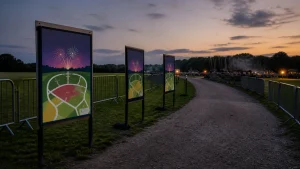
A vinyl banner may not make sense where the available space is very narrow, the message must remain legible at several distances, or a rigid sign would better suit the mounting surface. A-frame signs, display boards, large posters or directional signage may be worth considering for particular locations. For a complex message, several smaller signs placed along the visitor route can be clearer than one overloaded banner.
Installation conditions matter as well. Wind exposure, the strength of the fixing structure and local site rules should be considered before ordering. Do not assume that a bigger banner is always more suitable; a proportionate display with a straightforward message is generally easier to position and maintain.
Conclusion
Choose outdoor banner dimensions from the viewer’s position outward: identify the first useful viewing point, give the main message the greatest visual priority, measure the available space and simplify anything that does not need to be read at a glance. For large vinyl banner printing, sharing the location, intended dimensions and artwork purpose early helps create a tailored banner that suits the setting rather than merely filling it.