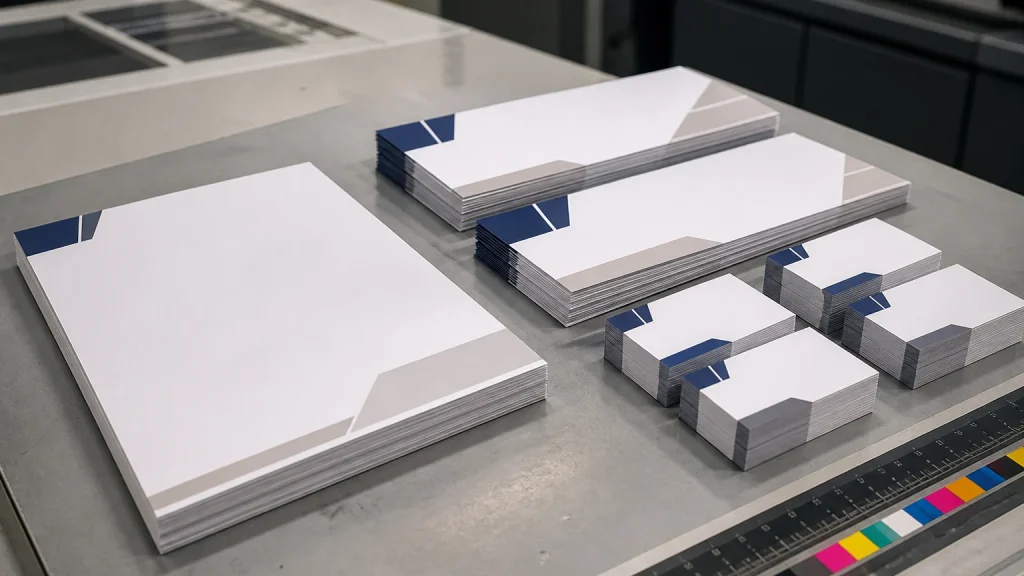
Litho printing can be a sensible choice for repeat stationery orders when your organisation uses the same branded items, expects to order in quantities and wants one specification to carry between batches. It is worth considering for letterheads, compliment slips, business cards and core stationery that is unlikely to change soon. The right choice depends on your quantity, artwork and how stable your business details are.
⏱️ Estimated reading time: 6 minutes
Table of Contents
Why litho printing suits repeat stationery
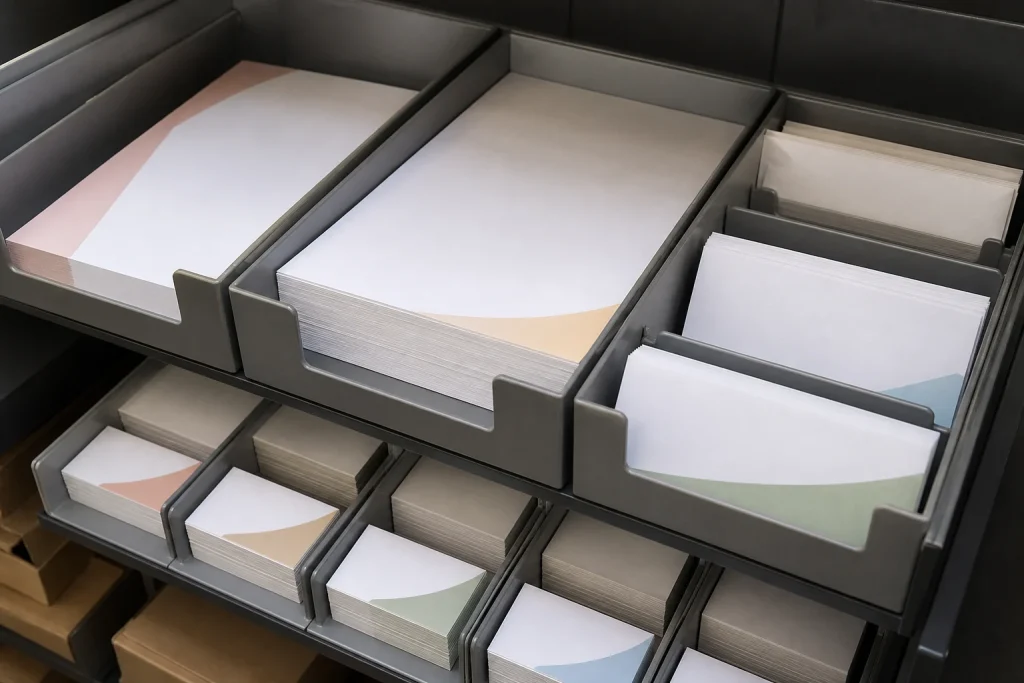
Repeat stationery is different from a one-off campaign leaflet. It supports everyday communication, so small inconsistencies can soon become noticeable. A letterhead with an old address, a business card in an off-brand colour or a compliment slip using an outdated logo can make a set of materials feel less joined up than it should.
Litho printing is commonly considered for larger, repeat orders because the initial setup is spread across more copies. That does not make it automatically the best value for every sizeable order. It does mean that a settled, repeatable specification deserves a conversation about litho rather than reordering the first option.
For stationery, the useful question is not “How many do we need today?” Ask how many pieces you are likely to use before the next change to your contact details, branding or legal information. That gives you a realistic basis for comparing approaches.
Start with a realistic stationery forecast
Before requesting a quote, separate the items your team uses continually from those ordered only occasionally. Letterheads for correspondence may be used at a steady pace. Individual business cards are variable, particularly if job titles, phone numbers or staff lists change regularly. A mixed order does not have to use a single print method.
It helps to create an internal list showing the product, approved version, likely users and reorder point. Avoid guessing based on the largest order you made in the past; a busy month, a drive or a one-off mailing can distort the picture.
- Core stock: letterheads, compliment slips and generic cards with stable details.
- Variable stock: named cards or items with changing prices or dates.
- Occasional stock: event inserts or seasonal stationery.
This split makes a practical brief. Your printer can assess whether the stable core items suit litho printing while variable pieces may be better handled differently.
Litho printing or digital printing?
The choice is about the pattern of use, not a rule that one method is “better”. Litho printing may suit stationery with a fixed design and a quantity large enough to justify production. Digital printing can be more appropriate for a modest run, different names or details, or artwork that may change before a larger order.
Consider a hypothetical professional-services firm with a permanent logo, address and telephone number. Its shared letterheads and compliment slips may be candidates for a litho specification. The same firm might keep named cards digital if staff contact details change. That combination can reduce the risk of holding stock that becomes obsolete.
There are trade-offs. A larger order needs space, a system and an owner who notices when a rebrand or address change is coming. A smaller digital order may offer more flexibility, but could require more frequent administration.
Keep the branded specification stable
Consistency starts before production. Keep a master artwork file for each stationery item and make clear which version is approved. Store logo files, brand colours, typefaces, wording and contact details together where the relevant people can find them. If an external designer creates the artwork, retain the approved files.
For each product, document the size, whether it is printed on one or both sides, the paper choice and finish you have agreed. These details should be confirmed with the printer rather than copied from an old order. Paper availability and production options can vary, especially where a job has a bespoke requirement.
An approval route matters. Someone should check names, phone numbers, web addresses, company information and spelling before a repeat order goes ahead. Another person should confirm that the design still reflects the current brand. It sounds basic, but stationery errors tend to be repeated many times once production starts.
Common mistake: ordering too much too soon
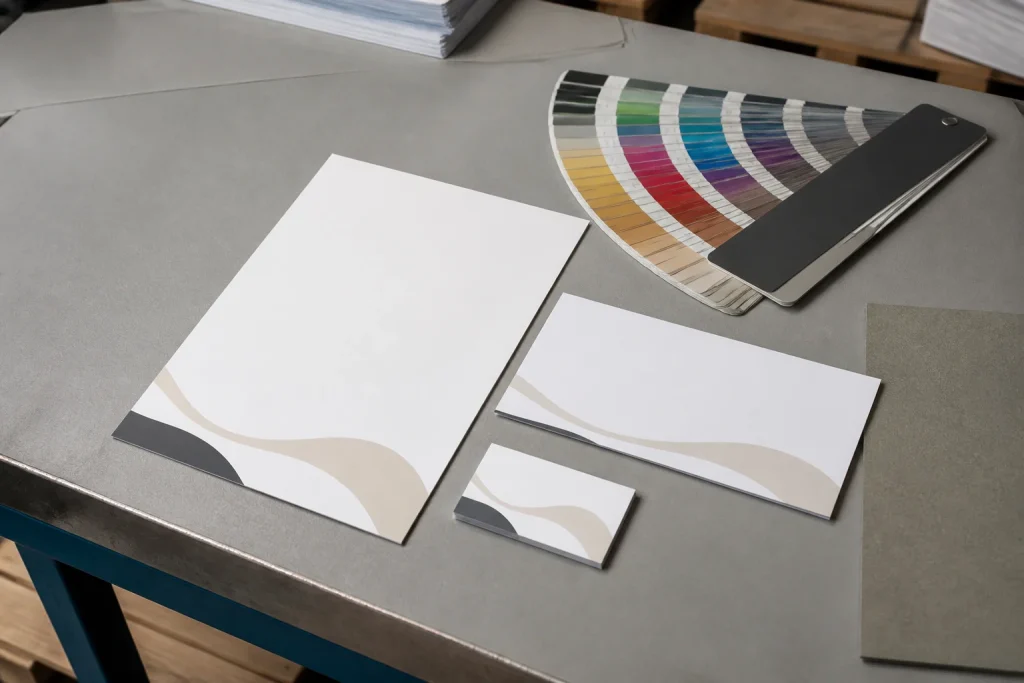
The common mistake is treating a larger quantity as a saving without testing whether the stationery will remain usable. A logo refresh, office move, new email domain or change in trading information can turn economical stock into a cupboard problem. If a change is likely, a smaller run may be the sensible decision even where litho printing would be under consideration.
Another issue is allowing several versions of the item to circulate. A team may use an old letterhead while another department orders a revised one, and the brand begins to drift. Set one named person or approval group to control stationery files and reorder decisions. It need not be bureaucratic; it prevents costly confusion.
Do not assume that a previous order can be reproduced without discussion. Tell the printer what stayed the same, what has changed and whether you still have an artwork file. An accurate brief is more useful than “match last time”.
When litho printing does not make sense
Litho printing is unlikely to be the first choice when you only need a small quantity, the design is being tested or the content changes from one version to another. It may also be less suitable for stationery tied to a promotion, a new business settling its identity, or cards with revised details.
In those situations, digital printing may give you the flexibility to order closer to need. The point is not to avoid litho printing; it is to reserve it for material that is repeatable. Ordering less, more often can be a form of control when change is likely.
Conclusion
Litho printing suits repeat stationery orders best when the artwork is approved, the brand details are stable and expected usage supports a planned quantity. Build a clear specification, distinguish fixed stock from variable items and check for upcoming changes before committing. Newstyle Print offers lithographic and digital printing alongside design support, so a detailed brief can be assessed against the practical needs of each part of your stationery order.