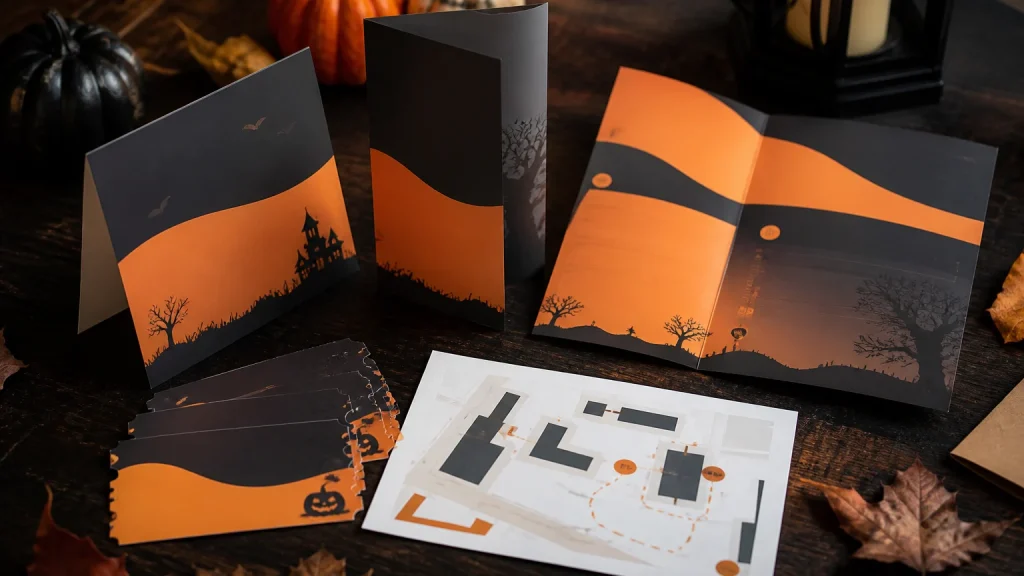
Halloween print helps guests arrive prepared when it makes the practical details impossible to miss: what the event is, where it takes place, when to arrive, how to enter and what to bring. Invitations, leaflets, posters and menus can create seasonal atmosphere, but each item should first remove a likely point of confusion before the guest leaves home.
⏱️ Estimated reading time: 6 minutes
Table of Contents
Start Halloween print with arrival questions
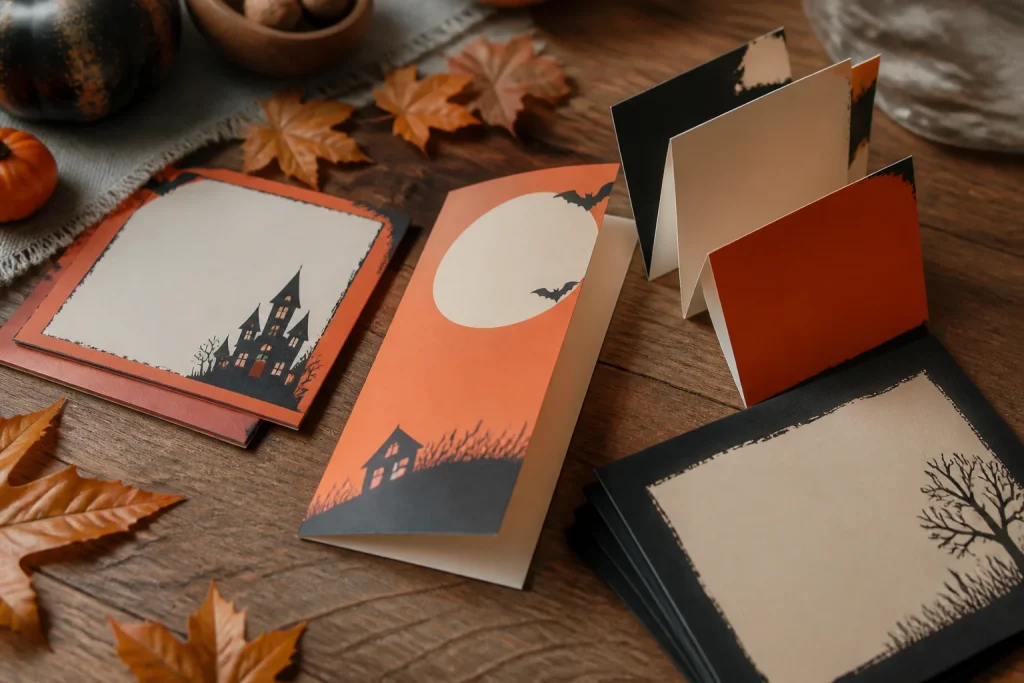
Plan the printed message around the moments between hearing about the event and reaching the venue. A guest may see an invitation weeks ahead, revisit it while making plans, then check it again while travelling. The information needed at each point should be easy to find without reading a dense block of themed copy.
Gather the fixed details before artwork begins: event name, date, start time, finish time where relevant, venue name, full address and an organiser contact route. Add any action a guest must take, such as booking, replying, presenting an admission confirmation, selecting food in advance or checking an age recommendation set by the organiser.
Ask what could stop someone at their front door. For a family activity, the unanswered question might be whether an adult needs to stay. For a ticketed evening, it could be the entry point or arrival time. For a hospitality event, guests may need clear pre-order information. If a detail is unsettled, keep it off the main printed item rather than risk distributing an incorrect instruction.
Choose Halloween print formats by guest need
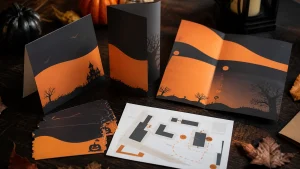
One format rarely handles every job well. An invitation should give a clear reason to attend and the essential facts. A folded leaflet can hold a programme, directions, activity timings or fuller arrival guidance. Posters are useful for promoting an event before the day, but should direct people towards a booking or contact route rather than attempt to explain every condition.
| Printed item | Best use | Information to prioritise |
|---|---|---|
| Invitation | Initial event notice | Date, time, venue and response or booking route |
| Confirmation card | Admission or booking reminder | Guest name or reference if supplied, entry details and arrival guidance |
| Folded leaflet | More detailed event information | Schedule, map, activity notes or organiser guidance |
| Menu or table card | Food and drinks information | Choices, timings and any ordering instructions |
| Poster | Pre-event visibility | Event headline, key date and clear next action |
For example, a hypothetical school fundraising evening might use invitations for families, a short programme at the entrance and posters in approved display areas. A restaurant hosting a themed evening may instead need a menu card and booking reminder. The useful mix depends on what guests need to know, not on producing every possible item.
Make event information easy to scan
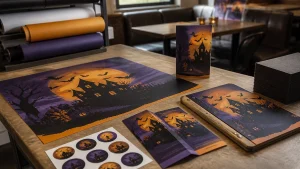
Halloween artwork can become crowded quickly. Dark backgrounds, cobweb textures, decorative lettering and several illustrations may set the mood, yet they can compete with the date and venue. Put the event name first, followed by the time and place, then the action guests need to take. Supporting details can sit beneath that core information.
Check that wording remains readable at the final printed size. Pale text over a detailed orange, purple or black background may look dramatic on screen but be difficult to read in a smaller invitation or leaflet. Do not rely on colour alone to distinguish ticket types, age groups, sessions or booking stages; clear labels are less open to misunderstanding.
A decorative typeface may suit a short headline, while a simpler typeface is normally easier for addresses, instructions and contact details. Leave space around these practical elements. Adding one more line to a packed design is a common mistake, and can make the whole piece harder to use.
Proof Halloween print against one event record
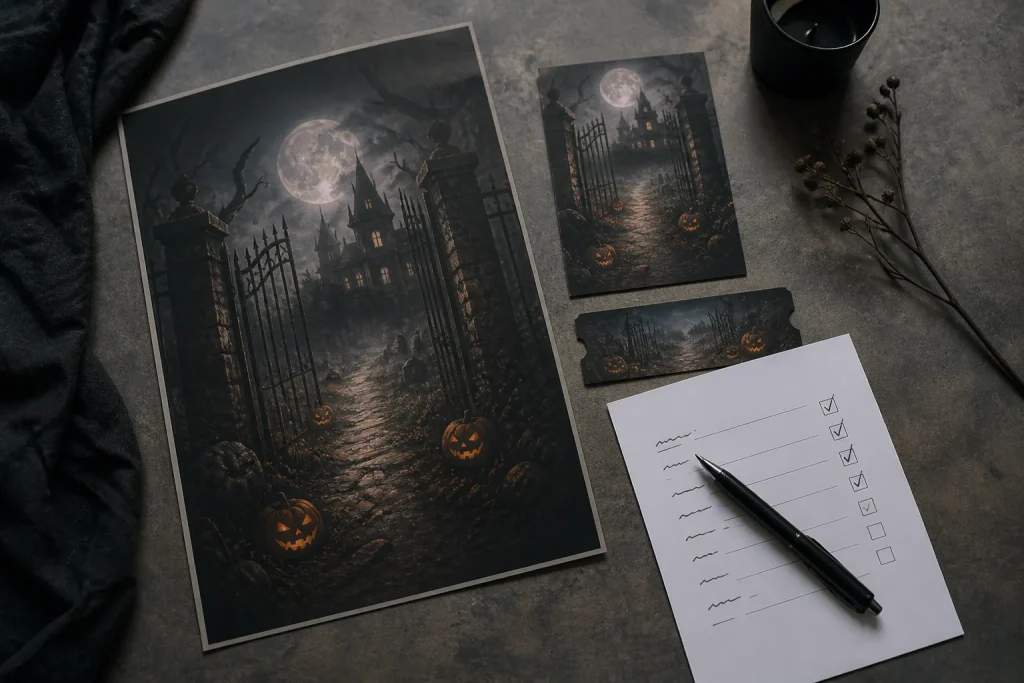
Proofing should go beyond spelling. Read the final artwork as a guest with no previous knowledge of the event. Can they distinguish the date from the time? Is the venue specific enough to find? Does the contact route work? If the organiser provides a QR code, web address or booking reference, test it from the final proof before approval.
Ask a second person to check names, dates, prices, punctuation and conditions supplied by the organiser. A fresh reader may notice an assumption missed by the person who created the layout. Compare every item with one approved event record so that an invitation, poster, leaflet and menu do not carry slightly different versions of the same instruction.
Confirm the specification early as well. Quantity, finished size, flat or folded format, single- or double-sided layout and the need for design support all affect the print discussion. Digital printing may suit some smaller or changing quantities, while litho printing may be worth discussing for a larger, settled run. The appropriate method depends on the order requirements rather than a fixed rule.
Keep changing details out of printed materials
Print is not always the right home for information likely to change at short notice. A revised arrival instruction, weather-related update or sold-out activity is generally easier to manage through the organiser’s current communication channels. Keep printed invitations focused on stable facts, then point guests towards the appropriate place for live updates where that is needed.
Do not make guests decode the theme either. A playful event name may need a plain-English line explaining whether it is a party, trail, meal, family activity or ticketed evening. Mystery can support the atmosphere; uncertainty about practical arrangements is less helpful.
Where an event has several locations, age groups or sessions, separate versions may be clearer than one general item overloaded with exceptions. This can mean more preparation at the artwork stage, but it gives each guest information that applies directly to them. Bespoke print work can be useful where standard formats do not fit the event plan.
Conclusion
Effective Halloween print gives guests the confidence to arrive at the right place, at the right time, with the right expectations. Begin with confirmed event details, select only the printed formats that solve a real communication need, and proof every version against one approved record. Once the message, quantity and format are clear, Newstyle Print can discuss invitations, leaflets, posters, menus or a bespoke printed requirement, with design support where needed.