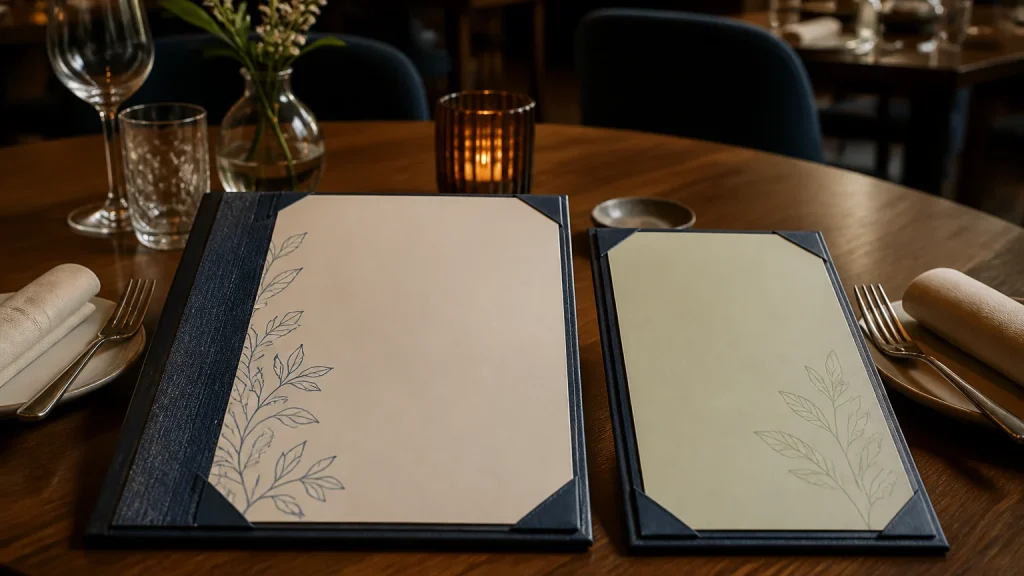
Custom printed menus UK hospitality businesses order can still work well when dishes, prices or seasonal offers change often. The key is to separate the parts that are likely to stay put from the details that may need revision, then order a quantity and format that match that rhythm.
⏱️ Estimated reading time: 6 minutes
Table of Contents
For a café, bar, restaurant or takeaway, an out-of-date menu can create awkward conversations at the till and make the offer look less considered than it is. A little structure before you order helps you keep the menu clear, current and recognisably yours.
Plan custom printed menus UK around changeable details
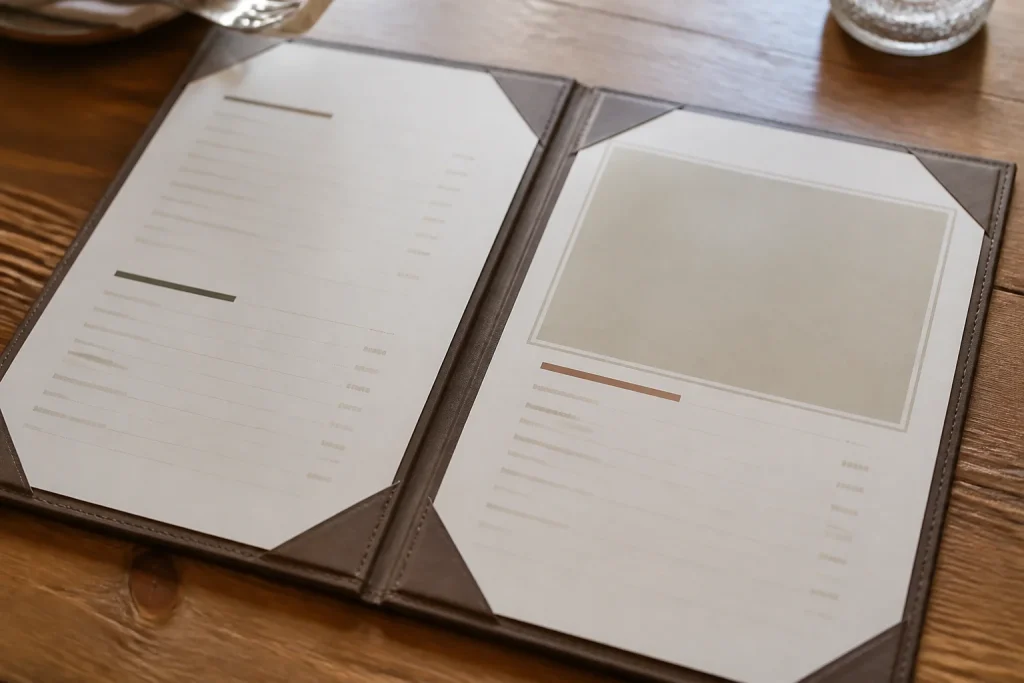
Begin by listing every part of the menu that could alter in the next few months. Prices, daily specials, seasonal dishes, allergens, availability notes, drinks and opening information may all move at different speeds.
This simple split affects the format you choose. A single-sheet menu may suit a short, focused list that changes as a whole. A folded menu can give you more room for a broader food and drinks offer, but it asks for more care: a dish name or price should not sit across a fold. Separate inserts can be useful where one section changes much more often than the rest, such as a dessert list or a limited seasonal selection.
Keep each updateable element in an editable master file, rather than changing an old PDF whenever something shifts. Give the file a clear version name and nominate one person to approve final wording.
Choose a print approach that matches your menu cycle
The best production route depends on the quantity you need, how frequently the content changes and whether every copy is identical. Digital printing may be a practical option for a smaller menu batch or a revision you want to test before committing more widely. Litho printing may be worth discussing when you have a settled design and require a larger quantity. There is no universal break point; quantities, size, paper choice, colours and current supplier specifications all affect the decision.
| Menu situation | Useful starting point | Watch for |
|---|---|---|
| Frequently changing specials | A short separate insert or small batch | Keeping its design aligned with the main menu |
| Stable core menu with seasonal additions | A lasting main menu plus a revised seasonal piece | Clear dates and consistent category names |
| New concept or revised offer | A modest first run | Checking content with the team before reordering |
| Several sites using one menu | One approved master layout with controlled local details | Accidentally mixing prices or contact information |
A takeaway with a compact, fast-moving offer may find that a single sheet is easier to replace.
Build custom printed menus UK layouts staff and guests can use
Menus are working documents, not simply brand displays. Group items in a sequence that makes sense for the way people order: for example, drinks, starters, mains, sides and desserts. Keep dish names, descriptions and prices consistently positioned. If prices appear in different places on every line, readers have to work harder than they should.
Leave enough room for revisions. An overly tight layout can turn a minor wording change into a complete redesign because a longer dish name no longer fits. Where descriptions are likely to change, use a flexible text area instead of filling every gap with decorative elements. Avoid relying on tiny type to solve a crowded page; cutting a less important sentence is usually the better fix.
Branding matters, but legibility comes first. Choose a typeface and colour contrast that remain comfortable to read in the venue’s usual lighting. A pale coloured font over a busy photograph may look appealing on screen yet prove less useful at a table. Ask for a proof and review it as a menu, not just as artwork: can somebody find a section, compare options and spot a price without hunting?
Common mistakes with custom printed menus UK
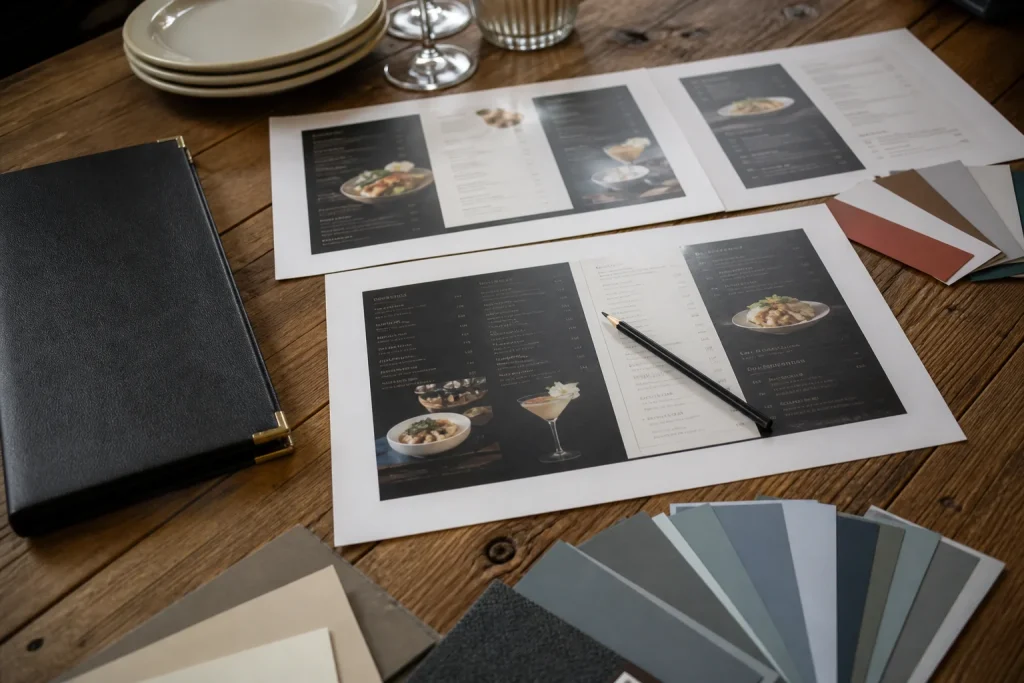
The most expensive menu is often the one ordered before the content has been properly checked. Common errors include copying descriptions from several documents, leaving discontinued items in place, using inconsistent capitalisation, and allowing a promotional price to become part of the permanent artwork.
Another mistake is ordering a large quantity because the design is attractive, without considering how long the information is likely to remain accurate. Bigger runs can make sense for a stable menu, but they can leave you with redundant stock if the offer is still being refined. It is worth being candid about expected changes when requesting a quote.
Do not treat food and allergen information as a design afterthought. Your menu wording should be reviewed against your own current recipes, ingredients and operational procedures. If information is uncertain, resolve it internally before print approval rather than guessing or relying on an old menu. Print can reproduce approved content clearly; it cannot validate it for you.
When a fully printed menu does not make sense
A fully printed menu may not be the best fit if your selection changes daily, prices are being altered frequently, or staff are still finalising recipes. In that situation, a smaller printed core menu supported by a carefully managed temporary insert may be more realistic. Some venues also use a printed drinks or food menu alongside another in-venue format for daily changes.
That does not mean printed menus lose their place. A well-made physical menu can establish the tone of the venue and gives guests something easy to handle at the table. It simply needs an update plan. Think about what changes, who signs it off, how many copies you need and what happens to older versions before placing the order.
Conclusion
Changing offers are a reason to plan custom printed menus UK orders more carefully, not to settle for confusing or inconsistent materials. Separate stable branding from variable content, select a format that reflects your update cycle, and check every version before it goes to print. Newstyle Print can help with printed menus, design support and bespoke requirements, with UK delivery available. When you request a quote, include your preferred format, quantity, artwork status and the parts of the menu you expect to revise so the conversation starts in the right place.