
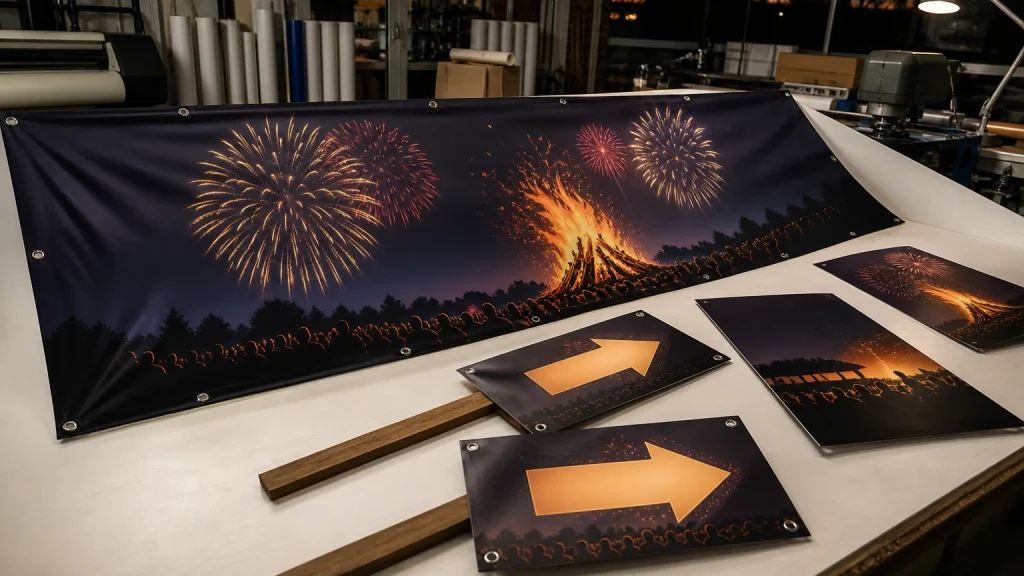
Bonfire night banner printing is most useful when the banner carries information that is unlikely to change: the event name, date, venue and organiser. Ticket arrangements, opening times, parking plans and programme details can move late in the planning process, so they may be better placed on supporting print or an updateable digital channel. This keeps the main display relevant for longer and reduces the risk of visitors seeing outdated information. It also gives organisers a clearer brief at a busy time.
⏱️ Estimated reading time: 6 minutes
Table of Contents
- Separate fixed details from flexible event information
- What bonfire night banner printing should communicate first
- Use bonfire night banner printing with supporting print for changing information
- Plan bonfire night banner printing around approvals
- Avoid treating a banner as a live noticeboard
- Conclusion
A banner is a prominent piece of event print, not a complete noticeboard. Its job is to help people recognise the occasion and understand the essentials quickly. Before artwork starts, separate every proposed message into confirmed facts and details still awaiting approval. That small exercise can prevent a crowded design and makes it easier to decide which information belongs on posters, directional signs or event notices instead.
Separate fixed details from flexible event information
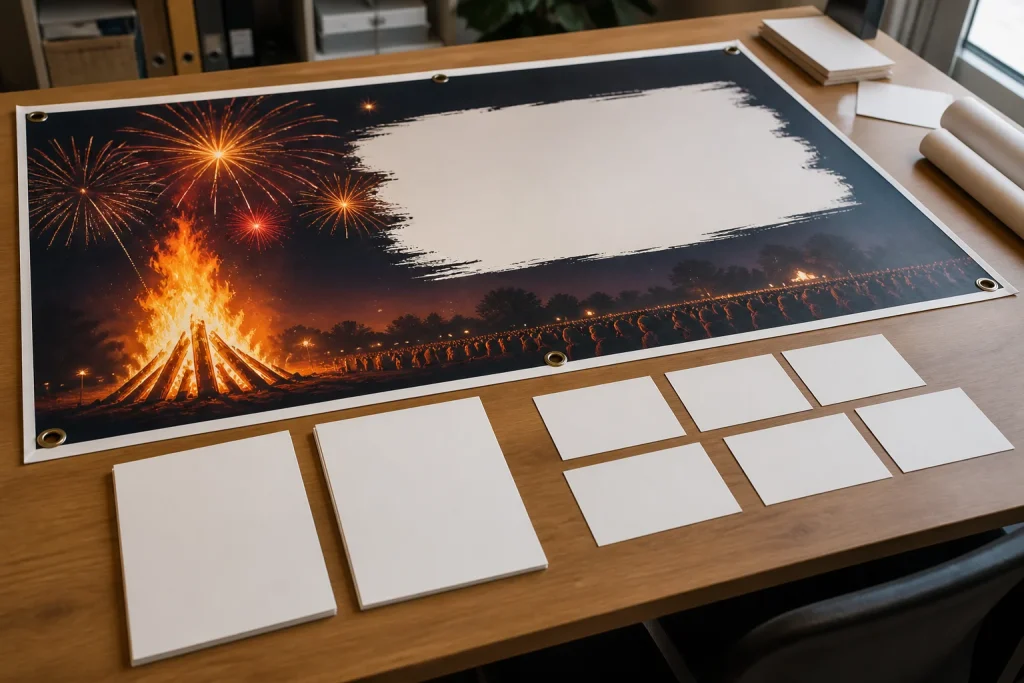
Some details are stable from the outset, while others depend on final arrangements. The event title, date, venue name, organiser name and approved event branding may be suitable for the main banner. A broad, accurate message such as “Fireworks, food and family entertainment” can also work if those attractions are confirmed. Gate times, prices, booking instructions, stallholders, parking routes and weather-related updates are more likely to need revision.
The dividing line is not always exact. A venue may be confirmed while its preferred entrance is still being agreed. In that case, name the venue on the banner but leave the arrival instruction for a site sign or poster produced once the route is settled. A passer-by should be able to take in the central message without reading a timetable, map and ticket page at the same time.
What bonfire night banner printing should communicate first
Give the main message the greatest visual space. A simple hierarchy usually puts the event name, or a clear Bonfire Night message, first; the date and venue next; then a short supporting line or approved booking prompt. Organiser details can sit lower down. For a hypothetical school or community event, “Bonfire Night at Greenfield Park, 5 November” is more resilient than a design containing a detailed schedule, several prices and directions that may be revised.
Short wording matters because a banner is often viewed from a distance or in passing. Choose one central message rather than several competing calls to action. If the design includes a contact method or QR code, check that it leads to information the organiser can keep current. The printed banner can then remain focused on the event identity while visitors can find the latest practical details elsewhere.
Use bonfire night banner printing with supporting print for changing information
Bonfire Night promotion does not have to rely on one item. A coordinated set might include a headline PVC banner, posters for local notice points, site signage for entrances and queues, and smaller notices for information that may change. Each format has a distinct purpose. The banner promotes the occasion before the event and identifies it at the venue, while posters and notices can carry fuller information once it has been confirmed.
Foamex boards, Correx boards and other signage options may be considered for location-specific messages, depending on the site, display method and event requirements. A revised parking route, for example, may call for replacement arrival signage rather than a redesign of a promotional banner already displayed elsewhere. Ask for separate artwork files for each use. Shrinking a busy banner design across every format can make essential information hard to read.
Plan bonfire night banner printing around approvals
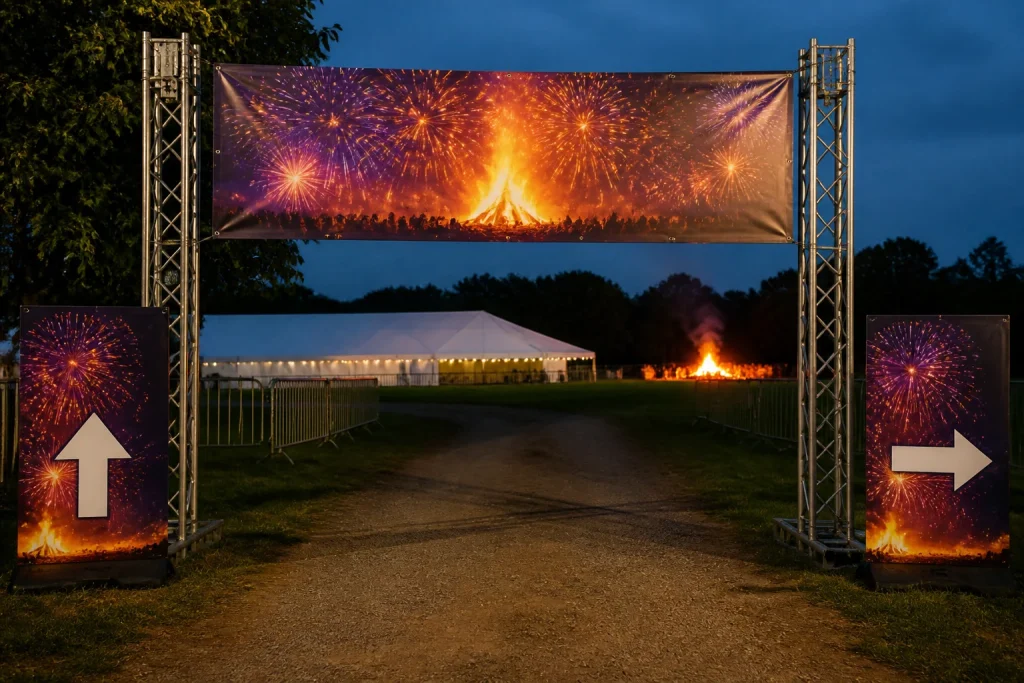
Agree who can approve wording, branding and event information before the design is finalised. One named decision-maker can help, provided they have a reliable way to collect confirmed details from the venue, event team and any sponsors. Without that process, late additions can turn a straightforward banner into a cluttered compromise. An approval list is useful: mark the event name, date, venue wording, logos, contact route and booking message as approved, awaiting confirmation or excluded.
A brief internal check before approval can also distinguish essential visitor information from material included simply because it is available. That distinction may keep late comments from displacing the event name, date or venue.
Check artwork carefully before it is sent to print. Compare dates and venue details with the current event plan, make sure supplied logo files are the intended versions, and review text close to the edges of the design. Test any QR code from the final artwork on a phone. If design support is needed, provide approved copy separately from background notes, along with logos and an indication of where each printed item will be displayed.
Avoid treating a banner as a live noticeboard
Trying to include every possible detail can feel cautious, but it often creates the opposite result: an overcrowded display that becomes inaccurate when one arrangement changes. A fixed banner cannot respond to late updates in the way an event page or social post can. Broad wording may help at an early planning stage, yet “details to be confirmed” is rarely a strong message for a main banner close to the event.
Instead, keep the display useful by featuring confirmed essentials and an approved route to further information. This approach is also kinder to the design. Clear space, readable type and a focused message usually do more for visibility than additional lines of small text. The supporting materials can then handle the practical questions that visitors need answered nearer the day.
Conclusion
Wait until the date and venue are secure before printing a specific Bonfire Night banner. If core arrangements are still uncertain, a general branded display may be more suitable until the event details are final. The strongest banner does not try to say everything. Build it around the event identity, date and venue, then use posters, signs and updateable channels for schedules, directions, prices and other operational information. A clear brief covering fixed copy, artwork and display locations helps keep every printed item purposeful.