Bonfire night flyers printing can guide arrivals by putting the event name, date, opening time, location, entry point and admission information where readers can find them quickly. The flyer should help someone decide when to leave, where to go and what to have ready before arriving, rather than trying to contain every detail about the event.
⏱️ Estimated reading time: 6 minutes
Table of Contents
Plan the arrival information before the design

Start with the visitor’s practical questions, not the fireworks artwork. A Bonfire Night flyer may be picked up days before the event, glanced at in a shop or passed between family members. Its core message needs to work even when the reader gives it only a few seconds.
Confirm one approved set of details before artwork begins. That record should include the event name, date, gates-open time, display time if relevant, full venue name, postcode, admission arrangement and the organiser’s current information route. If the event uses more than one entrance, separate vehicle and pedestrian access, or a collection point, make that clear rather than implying all visitors should arrive in the same way.
- State what is happening and who is organising it.
- Keep the date, venue and arrival time together.
- Explain whether entry requires a ticket, payment or donation.
- Use a clear route for current event information if plans change.
For example, a hypothetical school event might advertise gates opening before the fireworks begin. Printing both times avoids the common assumption that the display time is the appropriate time to arrive, which could leave families rushed or late.
Bonfire night flyers printing needs a clear reading order
Information hierarchy makes a flyer easier to use. Lead with the event name and date, then give the location and arrival time real visual prominence. Supporting copy about refreshments, entertainment, fundraising or sponsors can follow once readers understand the basic plan.
Group related information in short blocks. Put date, time and venue together; keep entry or ticket instructions in a clearly labelled area; and separate travel guidance from promotional copy. Readers should not have to piece together the essentials from opposite corners of the page. A short heading such as “Arrivals” or “Entry details” can be more helpful than a paragraph of mixed information.
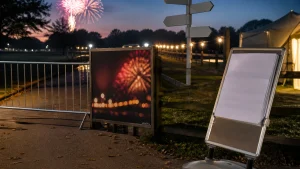
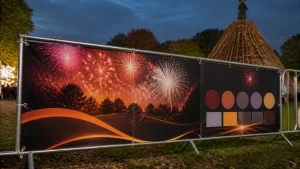
Seasonal artwork needs a careful contrast check. A dark background or firework photograph may fit the occasion, but pale type over a busy image can make a postcode, time or ticket instruction difficult to read. Leave a calmer area behind essential copy, choose legible type and avoid placing vital words inside decorative shapes. Festive design should support the message, not compete with it.
Plan bonfire night flyers printing across one or two sides
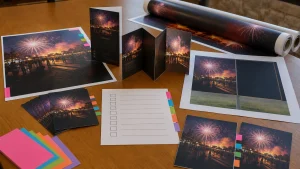
A single-sided flyer is often enough for a straightforward local event. It can carry the invitation, the essential arrival facts, a short reason to attend and one route to further information. This format is practical for handouts, counter displays and noticeboards where the reader needs a quick answer.
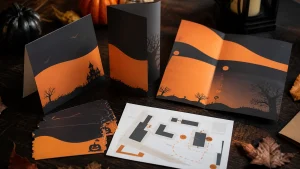
Use a second side only when it carries information that genuinely helps visitors. The front might handle the headline, date and venue, while the reverse gives a simple location plan, entry guidance, ticket notes or a concise programme. Repeating the same message in a different arrangement takes up space without making the flyer more useful.
Folded leaflets may suit an event with several activities, detailed schedules or separate areas that cannot be explained clearly on a flat flyer. They are not automatically the better option. A compact flat flyer can be easier to hand out, display and keep to hand, especially where the main aim is to direct people to one venue at a particular time.
Bonfire night flyers printing should follow distribution

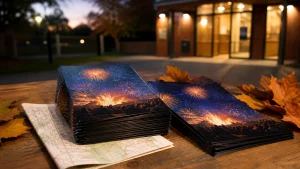
Decide how and where flyers will be seen before settling on the format, quantity and layout. A handout at a school gate, community venue or local business needs a headline that works at arm’s length. A flyer placed in a stack on a counter should still reveal its event name and date when only the top section is visible.
Plan quantities around named distribution points rather than choosing a convenient round number. List each venue, organiser or community partner receiving flyers, set an allocation and retain a modest reserve. This approach may reduce the risk of a large surplus if practical details are still awaiting approval.
Newstyle Print offers both digital and lithographic printing, so buyers can discuss the order rather than assuming one process suits every campaign. Digital printing may be a sensible conversation for a smaller or changeable order; litho may be worth considering when a larger campaign has settled artwork. Quantity, budget, timing and the finished specification all affect that choice.
Check details that can affect a visitor’s journey
A flyer is not a miniature poster. Posters are generally read while people are already out, whereas flyers are often read before a journey. That difference means an eye-catching headline alone is not enough. The printed piece needs to answer where to go, when to arrive and how entry works.
Print only information that has been approved. A provisional parking instruction, unclear ticket arrangement or outdated contact detail can cause confusion once copies are circulating. Compare the final artwork against the approved event record and check names, dates, times, postcodes, phone numbers and any QR code destination in the same review.
Do not attempt to fit every rule, activity and contingency plan onto the flyer. If the organiser maintains detailed event guidance elsewhere, direct readers to that current information and keep the print focused on the key arrival points. A crowded layout can bury the exact details visitors need most.
Conclusion
Bonfire night flyers printing works best as an arrival guide as well as an event invitation. Give priority to the date, gates-open time, venue, entry route and admission details, then use the remaining space for concise supporting information. Before ordering, prepare one approved event record and decide whether a single-sided flyer, double-sided flyer or folded leaflet genuinely matches the amount of guidance visitors need. Newstyle Print can discuss digital, litho and bespoke print requirements when the final quantity, artwork and distribution plan are clear.