Vinyl banners with eyelets are only as secure as the fixing plan behind them. Eyelets create practical attachment points, but they do not remove the need to assess the banner’s location, supporting structure and likely exposure to wind. A sensible plan starts by deciding where the banner will sit, what it will be fixed to and whether every edge needs support. That approach helps a PVC banner look neater and reduces the risk of avoidable strain during installation.
⏱️ Estimated reading time: 6 minutes
Table of Contents
- What banners with eyelets are designed to do
- Plan vinyl banners with eyelets around the available support
- Choose a fixing method that suits the location
- How vinyl banners with eyelets affect tension and wind judgement
- Keep eyelets clear in the banner artwork
- Common mistakes with vinyl banners with eyelets during ordering and installation
- Conclusion
What banners with eyelets are designed to do
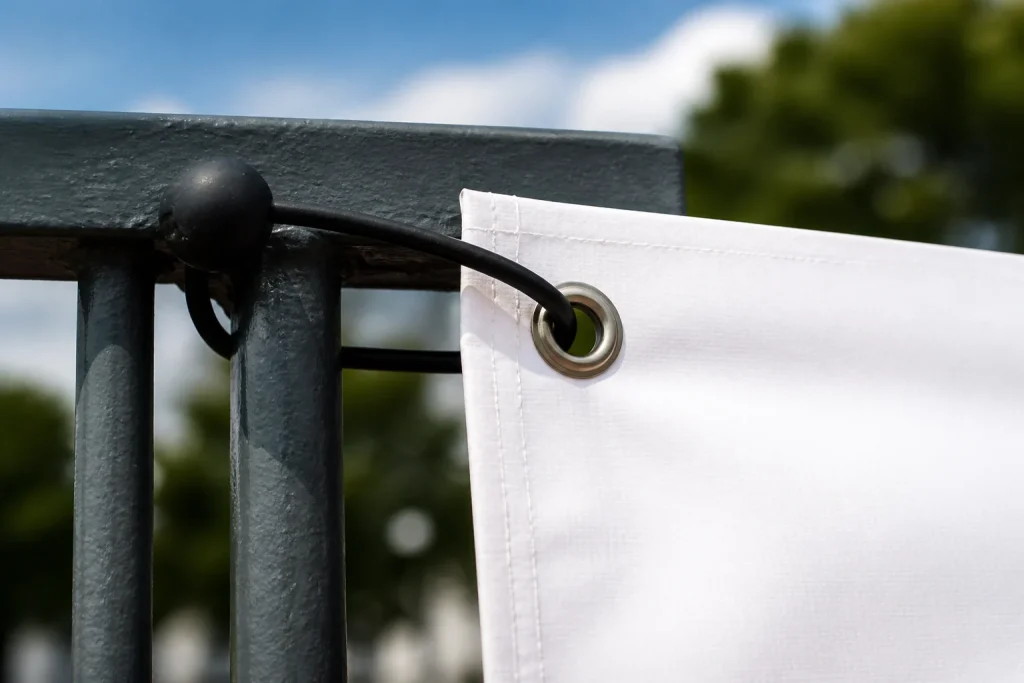
An eyelet is a reinforced opening around the edge of a banner that allows a tie, cord, hook or other suitable fixing to pass through.
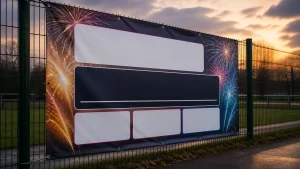
Before requesting a quote, describe the intended location and support where possible. A banner fitted to a solid frame calls for a different approach from one attached to temporary railings or a chain-link fence.
Plan vinyl banners with eyelets around the available support
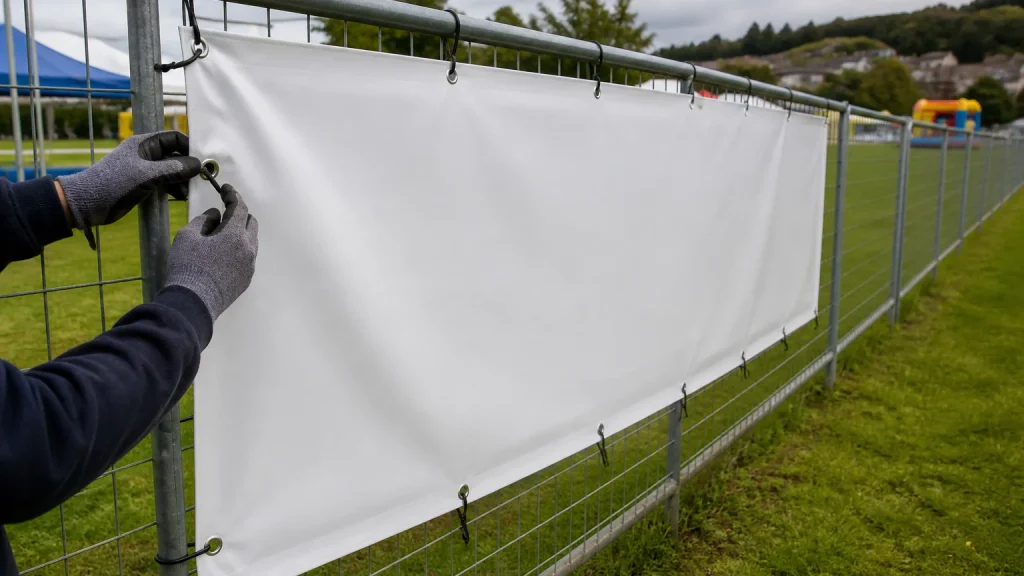
The most useful fixing-point layout follows the structure available on site. First identify where the support is strong enough to accept a fixing. Then consider how the banner can be held evenly across its top edge and, where appropriate, its sides and bottom edge. A banner that is secured at only a few isolated points may sag between them or move unpredictably.
Look at the whole perimeter rather than focusing solely on the corners. Corners are natural starting points, yet they can take disproportionate strain if the rest of an edge is left unsupported. More evenly distributed attachment points may help spread the load, although the suitable arrangement depends on the banner’s dimensions, the support and local conditions.
Choose a fixing method that suits the location
Eyelets can work with several kinds of fixing, but the right choice is not universal. Cable ties may suit some railings and mesh fencing. Bungee-style fixings can allow some movement where a rigid connection may place more stress on the banner or support. Rope or cord may be appropriate when it can be tied securely and checked easily. Hooks may be useful on a purpose-made frame, provided they cannot work loose.
| Installation situation | Planning priority |
|---|---|
| Fence or railings | Match fixing points to solid, reachable rails and avoid unsupported spans. |
| Purpose-made frame | Align eyelets with the frame and plan even tension around the perimeter. |
| Temporary event setup | Confirm the structure is stable and that fixings can be checked during the event. |
| Exposed outdoor position | Assess wind exposure, support strength and whether a different display solution is more suitable. |
Do not use a banner as a substitute for a structural barrier, screen or safety system. If the installation is above ground level, near a road, across an entrance or in another higher-risk setting, the site owner or a suitably competent installer should determine the safe method.
How vinyl banners with eyelets affect tension and wind judgement
A banner should sit flat enough to be readable, but pulling it excessively tight can concentrate force at the eyelets, edges and fixing points. The aim is controlled, even tension rather than simply making the material as taut as possible. Recheck the banner after fitting: creases, a pulled corner or a bowed edge can suggest that tension is uneven.
Wind is the factor most likely to change the picture. A large solid banner can catch moving air, and conditions at an exposed school field, building frontage or event site may differ greatly from a sheltered courtyard. There is no single eyelet pattern or fixing method that is safe for every outdoor banner. If forecasts or site conditions appear unsuitable, postponing installation or taking the banner down may be sensible.
For example, a hypothetical sports-day banner on a low fence may be straightforward in calm conditions. The same artwork installed high on an open boundary could demand a very different assessment because the support and exposure have changed.
Keep eyelets clear in the banner artwork
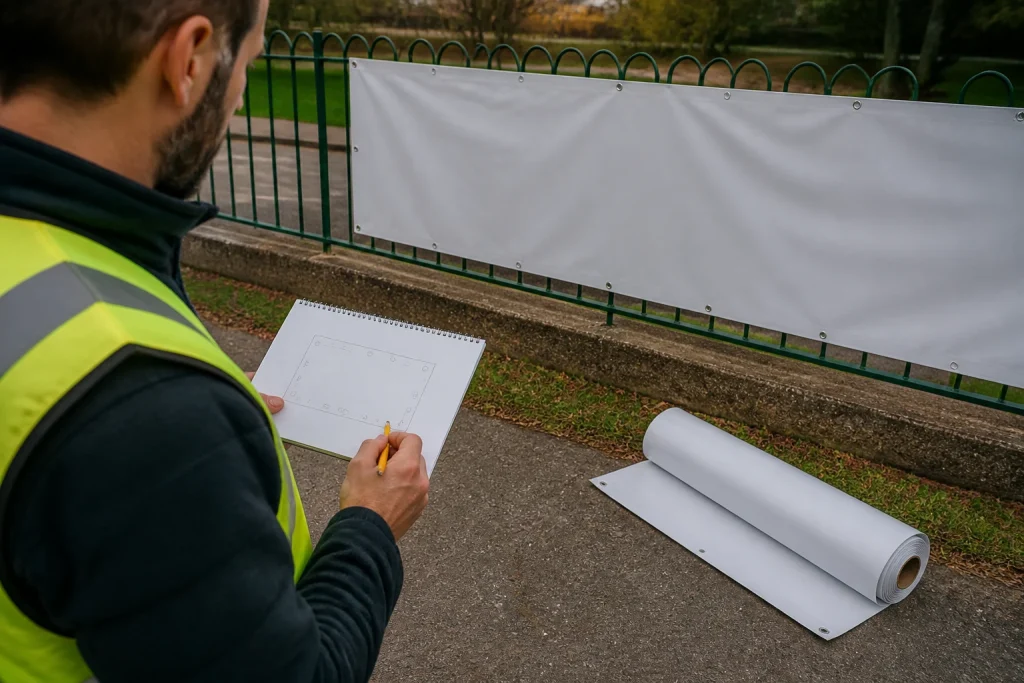
Eyelets occupy space close to the edge, so important design elements should not be placed where a fixing point may interrupt them. Keep key wording, contact details, logos and fine graphic details away from the perimeter. This is particularly important where a message runs close to a border or a logo sits in a corner.
Think about viewing distance as well. A banner usually needs a simple hierarchy: the main message first, followed by the information someone needs next. Packing the outer edge with small details creates two problems: it is harder to read from a distance and more likely to clash with finishing or fixings. A quieter margin often makes the finished banner feel more deliberate.
Supplying the finished size, intended eyelet arrangement and a note about the display location with the artwork gives the print team useful context. It may also reveal whether the design needs a wider safe area before production.
Common mistakes with vinyl banners with eyelets during ordering and installation
One common mistake is focusing on the banner size without considering the support. A close second is assuming the corner eyelets alone will hold a large or exposed banner in place. Both issues can lead to a rushed workaround on installation day.
- Measuring only the open space, not the usable fixing points around it.
- Placing essential copy or a logo too close to the edge.
- Using mismatched or worn fixings without inspecting them first.
- Fitting a banner where it can obstruct a route, doorway, sign or safety feature.
- Leaving a banner in place when changing weather or a loose fixing makes the setup questionable.
There is also a point where a PVC banner with eyelets does not make sense. If there is no secure support, the location is highly exposed, or the display needs to be rigid and self-supporting, another format may be more suitable. A roller banner, A-frame or rigid display board could be worth discussing instead, depending on the setting.
Conclusion
Eyelets give PVC banners flexible fixing points, but they should be planned as part of the installation rather than added as an afterthought. Map the support, protect important artwork from the edges, choose fixings suited to the location and avoid over-tensioning the banner. Share the display plan early when ordering customised wide-format print.