
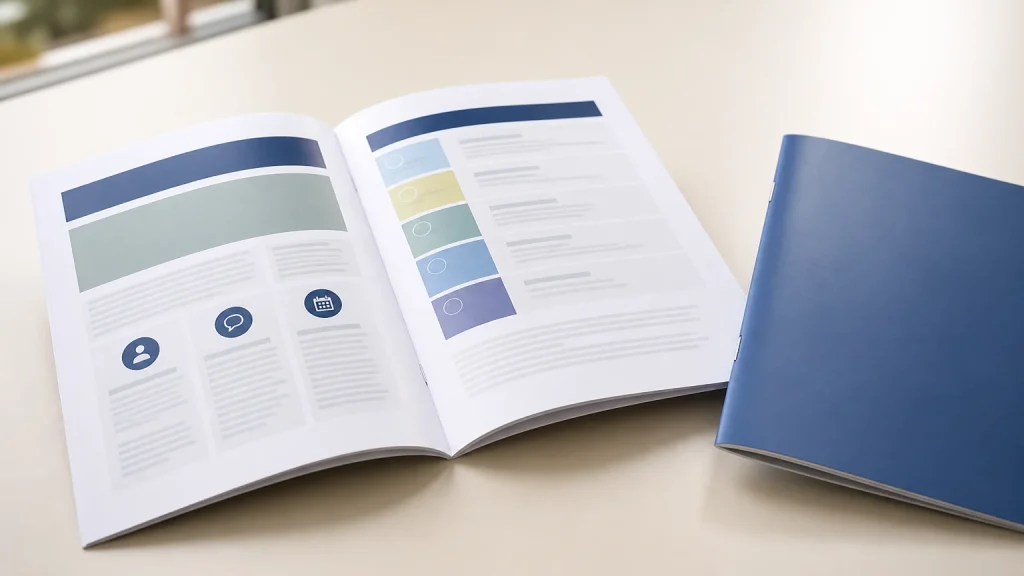
Professional stapled booklet printing services can support clearer communication when a booklet is planned around how people will actually read and use it, rather than around the cover alone. Clear copy, logical sections, readable type and considered paper choices can make a product guide, programme or information pack easier to navigate. A print supplier can help turn these decisions into a practical specification, while the organisation publishing the booklet remains responsible for the accuracy, suitability and accessibility of its information.
⏱️ Estimated reading time: 6 minutes
Table of Contents
- How professional stapled booklet printing services can help
- Plan the reader’s journey before the design
- Professional stapled booklet printing services for readable page layouts
- Paper, format and staples in professional stapled booklet printing services
- Do not leave accessibility until the proof stage
- Conclusion
How professional stapled booklet printing services can help
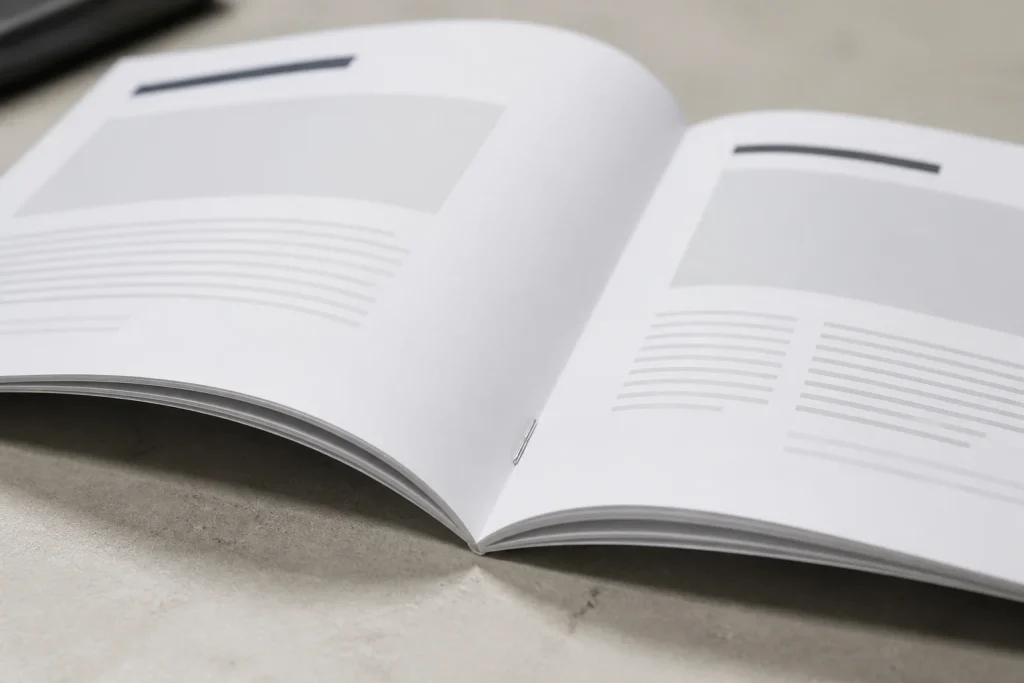
A stapled booklet, often described as saddle-stitched, is made from folded sheets secured along their central fold. It can suit concise material that readers need to carry, browse or refer to during an event, meeting or campaign.
A printer can discuss finished size, paper, page order and artwork setup before production. That early conversation may be particularly helpful where several people are supplying content, brand rules must be followed, or the audience has varied needs.
Printed information has limits. Readers who use screen readers, enlargement tools or alternative formats may also need a properly structured digital document or another route to the same content. Treat print as one useful way to share information, not necessarily the only one.
Plan the reader’s journey before the design
Start with the task the reader needs to complete. A training guide may need distinct sections and space for notes. A visitor booklet may need a prominent timetable, map and contact details. A product information booklet may need a repeatable layout so that options can be compared without searching through dense copy.
Headings, page numbers, plain-language labels and a simple contents list can make a real difference. They are functional navigation aids, not decorative extras.
For example, an event programme could group sessions by time, present each entry in the same order and keep directions separate from sponsor messages. That structure may reduce the risk of practical details disappearing among promotional material. The same principle applies to staff guides, customer packs and short reports.
Professional stapled booklet printing services for readable page layouts
Readable design is mostly about hierarchy and restraint. Choose a typeface that remains clear at the intended size, leave adequate space between lines, and avoid packing long paragraphs into narrow columns. Very light type, decorative fonts and words placed over busy photographs can look effective on screen but become tiring in print. Reviewing a proof at the intended finished size is more revealing than inspecting a highly magnified artwork file.
Contrast also needs a careful check. Dark text on a light, plain background is often easier to read than a low-contrast colour combination, although brand colours may still work well for headings, rules and call-outs. Do not use colour alone to show categories, status or instructions. A written label, icon or consistent position in the layout gives readers another way to understand the page.
- Keep one main message or instruction within each clear page area.
- Use short paragraphs and meaningful headings instead of uninterrupted blocks of copy.
- Check captions, tables, website addresses and contact details at final size.
- Ask someone unfamiliar with the content to find a few key facts in the proof.
That final check can expose problems that a project team no longer notices after several revisions. It is a practical test, not a substitute for specialist accessibility advice where that is appropriate for the organisation or audience.
Paper, format and staples in professional stapled booklet printing services
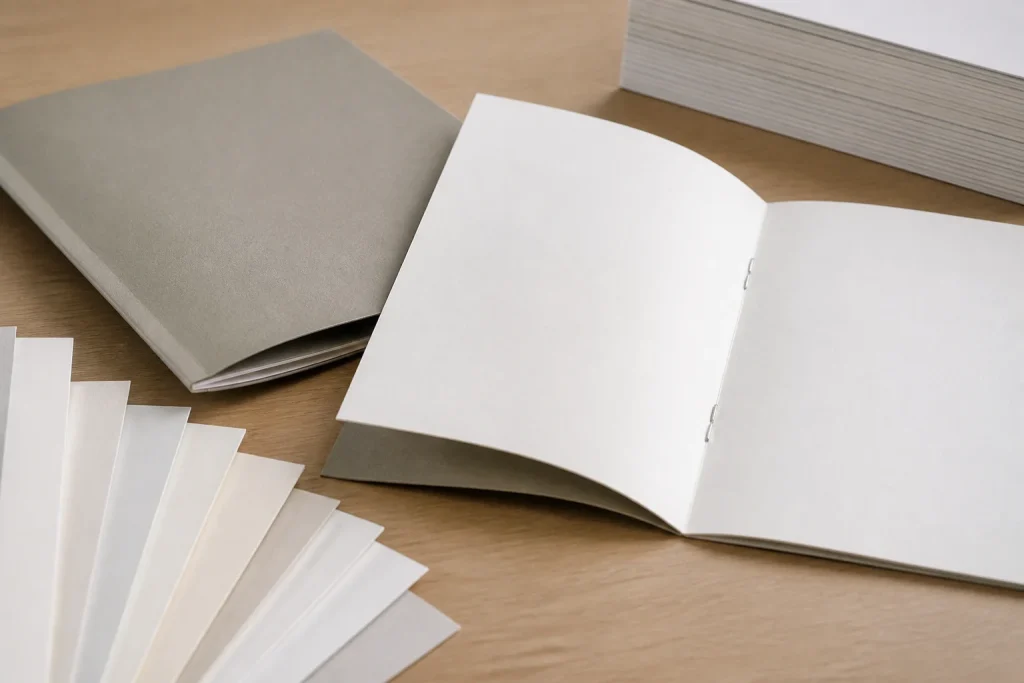
Paper affects handling and readability as well as appearance. A heavier cover may give a booklet more presence, while the inside pages need to suit the amount of text, imagery and any space needed for annotation. Glossy paper can suit image-led work, but a less reflective surface may be preferable for a text-heavy guide. There is no universal best stock; the choice depends on purpose, handling and visual priorities.
Choose the finished size around the content rather than what simply feels familiar. A compact format may be convenient in a welcome pack, while a larger one can give diagrams, tables and larger type more room. Page count, paper thickness and binding interact, so confirm the full specification before artwork is finalised. Stapled binding should be assessed against the proposed document, not assumed to suit every length or paper combination.
Digital printing may be worth discussing for smaller or changeable runs, while litho printing may be considered for larger quantities. The appropriate method depends on the order specification, so it is sensible to confirm current options with the print provider.
Do not leave accessibility until the proof stage
Leaving readability until a final proof often creates awkward compromises: smaller text to fit extra copy, a contents page removed to save room, or important information pushed into a crowded back page. Edit before designing. Remove repetition, divide complicated subjects across pages and decide whether supporting detail belongs in a separate handout or digital document.
It is also worth checking page sequence, trim areas and the centre fold before sending a PDF. A stapled booklet is built from folded sheets, and the artwork needs to account for pages meeting at that fold. Keep important text comfortably away from edges, and avoid placing a vital instruction where the fold could interrupt reading. The printer can advise on its current artwork requirements for the selected product.
If a document is long, frequently revised or intended for substantial note-taking, a stapled booklet may not be the most practical format. A different binding, a shorter printed summary or a digital companion may serve readers better. The useful question is not whether staples are standard, but whether the format supports the information.
Conclusion
Accessible booklet printing is not a single paper choice or a label added at the end of a project. It comes from clear information, calm layouts, suitable specifications and an honest view of what print can and cannot do. Before discussing a booklet, prepare its purpose, audience, finished size, page count, quantity, artwork status and required delivery date. For a bespoke job, confirm the proposed format, paper and artwork requirements with the supplier before production.