
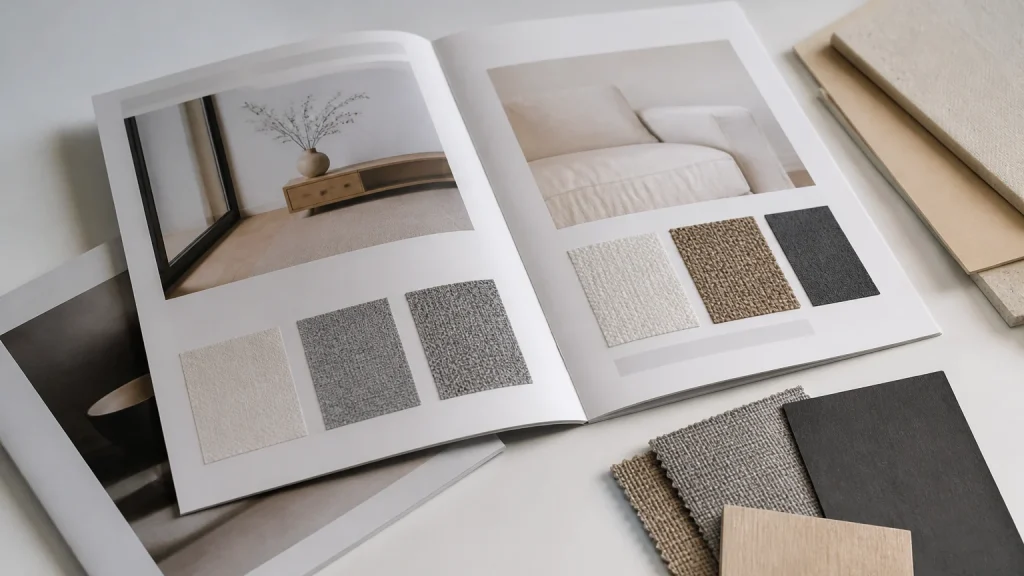
Bespoke booklet printing with staples can be a practical choice when product samples, swatches or inserts need a clear printed context rather than being handed over loose. The booklet can introduce the range, explain each item and keep the presentation compact. It is not automatically the right construction for every sample pack, though. The weight, thickness and method of attaching samples all need considering before artwork is started.
⏱️ Estimated reading time: 5 minutes
Table of Contents
- When bespoke booklet printing with staples suits samples
- Plan the sample before the printed pages
- Choose a format around handling and content
- Paper and cover choices for bespoke booklet printing with staples
- Common mistake: treating staples as the sample holder
- Artwork checks for bespoke booklet printing with staples
- Conclusion
When bespoke booklet printing with staples suits samples
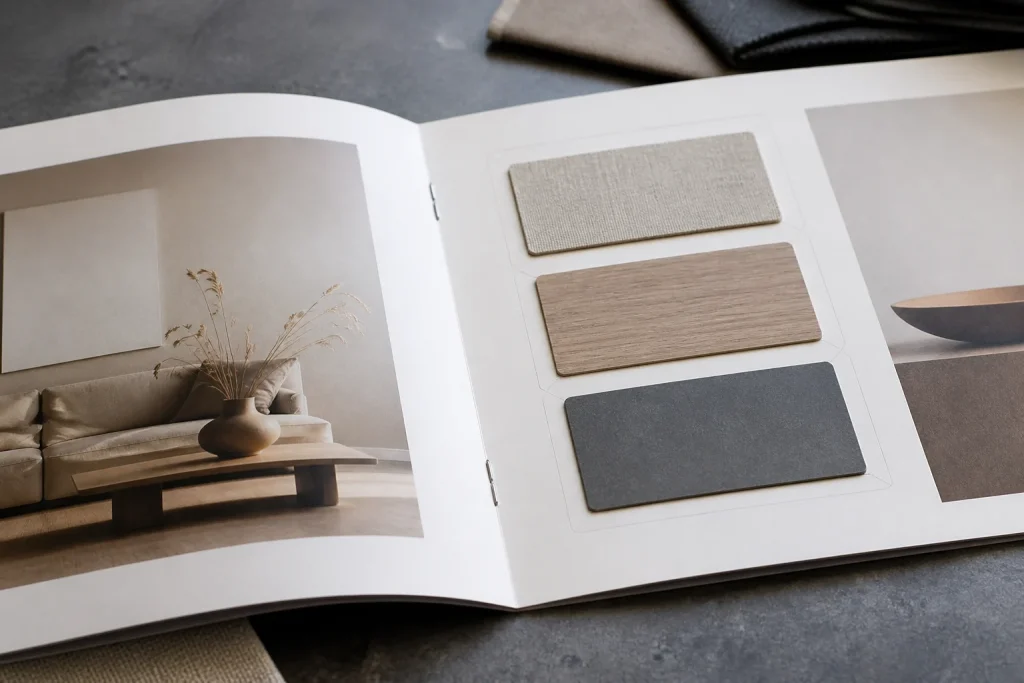
A stapled booklet works best when the printed pages remain the main item and samples support the message. Think of a small range guide with material swatches mounted on selected pages, a brochure containing a removable information card, or a launch pack with a slim insert tucked inside.
Plan the sample before the printed pages
The sample itself should drive the brief. Start by asking what it is made from, whether it is flat, how thick it is, and whether it needs to stay permanently attached. A thin, flat swatch may sit comfortably on a page; a raised item, several layered pieces or a loose component may make the booklet awkward to close, stack or post.
There is also a difference between an insert and a mounted sample. An insert is placed inside the booklet and can be removed. A mounted sample is fixed to a page, perhaps using an approved adhesive or another specified method. Some samples may mark nearby pages, pull away in transit or add more bulk than expected.
A useful brief states exactly where each sample belongs. For example, a hypothetical flooring supplier might want one labelled swatch on each product page, with a short description opposite. That calls for enough clear space around the swatch, a page stock that supports the intended attachment method, and a cover that does not conceal the samples when closed.
Choose a format around handling and content
Size is less about what looks impressive on screen and more about how the finished pack will be used. A compact booklet may be convenient for a sales visit, while a larger format can give product photography, technical notes and samples more room. Landscape layouts can suit wide samples; portrait layouts often suit straightforward reading. The best choice depends on the content and sample shape.
Keep in mind that stapled booklets are made from folded sheets. Pages are commonly planned in groups that work with this folded construction, so the proposed page count should be checked before copy is written or pages are laid out. Adding a single page late in the process may mean revisiting the plan rather than simply inserting one extra sheet.
| Requirement | Useful planning response |
|---|---|
| One flat sample per product | Allow a consistent sample area and clear labels on each relevant page. |
| Loose inserts for several recipients | Confirm how inserts will be placed and whether the booklet needs an additional enclosure. |
| Thicker or irregular samples | Request advice on a bespoke pack rather than assuming staples alone will hold it together. |
| Frequently updated range information | Consider keeping changeable details in a separate insert or producing smaller quantities. |
Paper and cover choices for bespoke booklet printing with staples
Paper choice affects both the printed impression and the practical job of carrying samples. A light text stock may be suitable for copy-led pages, but it may not be the most sensible base for a mounted item. A heavier cover can give the outer pages more presence, although it does not solve a booklet that is overloaded internally. Ask for advice based on the actual sample, not a description alone where possible.
Quantity and version control influence the printing method. Digital printing may be worth discussing for shorter runs, test packs or versions that are likely to change. Litho printing may be considered for larger quantities. The practical choice depends on the full specification, including size, pages, stock, colour requirements and how the samples are incorporated, rather than quantity alone.
Common mistake: treating staples as the sample holder
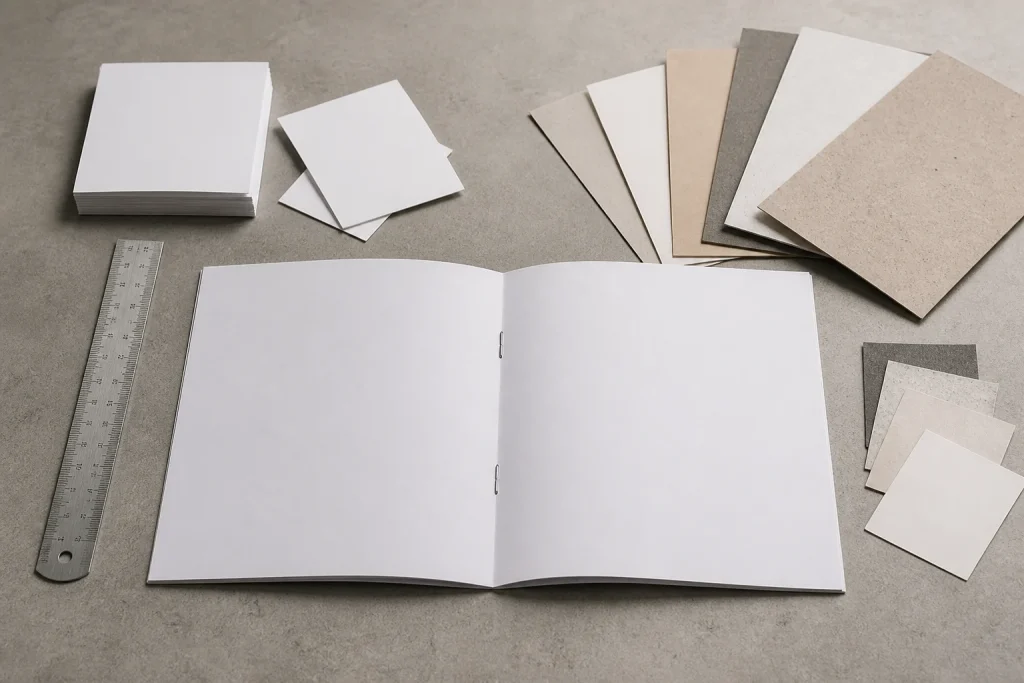
The most common mistake is designing a conventional booklet, then expecting the staples to manage the weight of the samples. Staples bind folded printed sheets at the spine; they are not a substitute for a purpose-designed holder, pocket or pack structure. If samples are heavy, uneven or likely to be handled separately, a different presentation may make more sense.
Another avoidable problem is putting samples too close to the fold. Material mounted across, or very near, the spine can stop pages lying flat and make copy difficult to read. Leave a sensible clear area around the fold and avoid placing key wording where a sample, staple or page curve could obscure it.
Finally, do not leave assembly assumptions out of the quote request. If samples need mounting, inserting or supplied alongside the printed booklets, describe that clearly. A printer can then assess the suitable route rather than pricing only the paper booklet and discovering a mismatch later.
Artwork checks for bespoke booklet printing with staples
Artwork should show the final page order, including covers, blank areas, sample positions and any inserts. Mark non-print areas clearly if they are needed for mounting. Supply final copy, approved images and brand assets together where possible, since last-minute text changes can affect the layout around samples.
Before approval, check product names, codes, colour references and instructions against the physical samples. Also check that each item has a clear label, that no important details sit too close to trim or the centre fold, and that the reader can understand the range without removing every sample. If artwork support is needed, Newstyle Print offers graphic design alongside booklet printing.
Conclusion
Bespoke booklet printing with staples is most effective for product samples when the booklet explains the range and the samples are light, flat and planned into the layout from the outset. For heavier, loose or awkward items, a different bespoke presentation may be more practical. Finalise the sample dimensions, attachment approach, page plan, quantity and delivery requirement before requesting a quote, so the printed booklet and its contents can be considered as one job.