
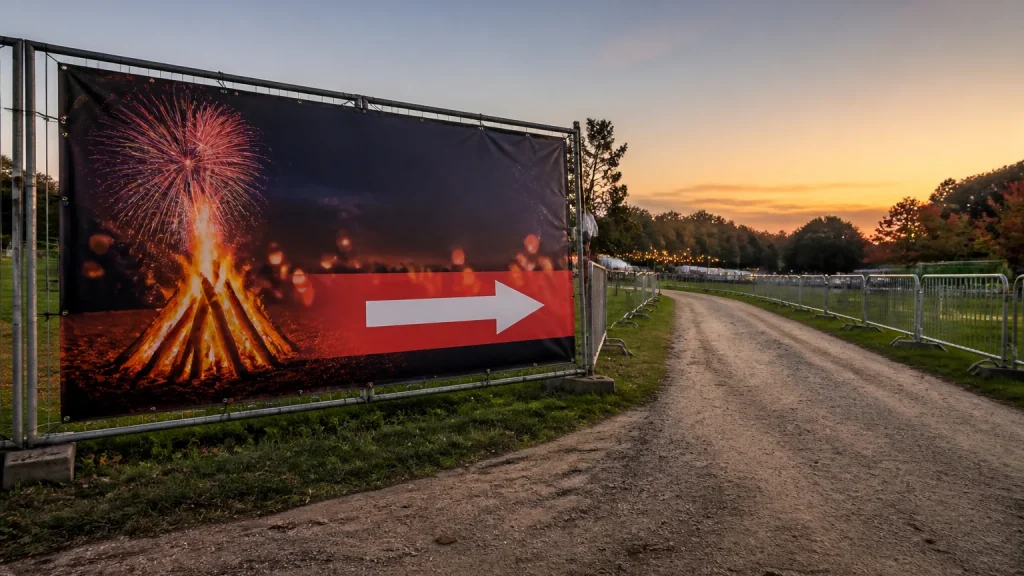
Large bonfire night banners work best when people can understand the essential event details in a glance, before they reach the entrance or join a queue. Start with the message that matters most: the event name, date, opening time or a simple directional instruction. Then plan the banner around where it will be seen, how fast visitors may be moving and what else is competing for attention.
⏱️ Estimated reading time: 5 minutes
Table of Contents
Large bonfire night banners start with one job
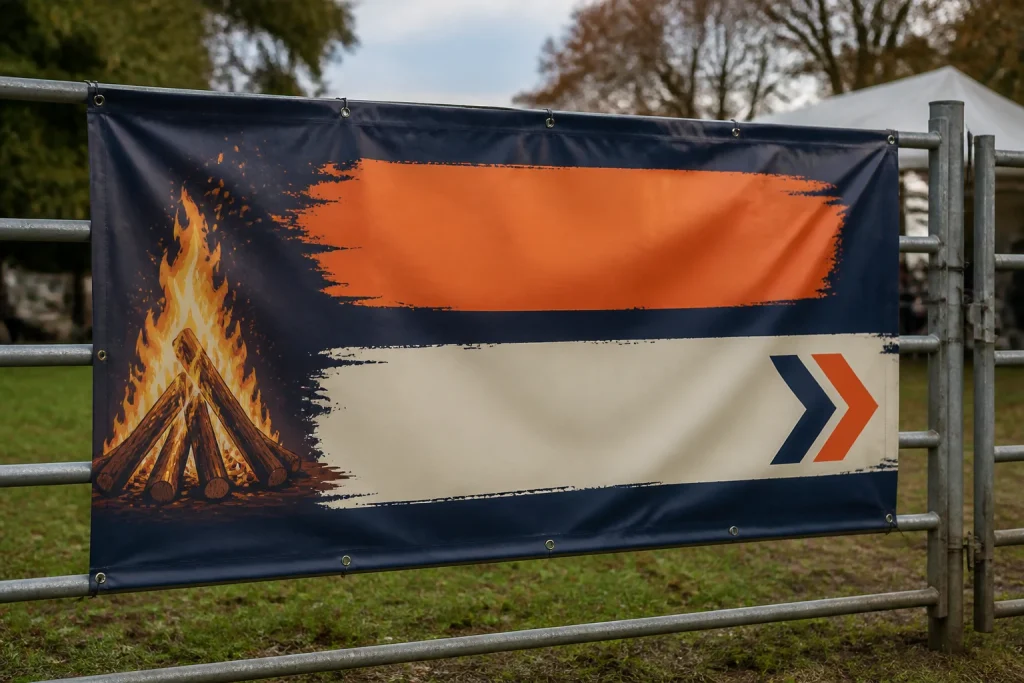
Before discussing size, material or artwork, decide what each banner needs to achieve. A banner at the roadside may need to announce the event. One by the gate may need to confirm the correct entrance. A display near the refreshments area could point people towards a collection point, toilets or another part of the site. Trying to make one banner do all of those jobs usually produces a crowded result.
Write a single purpose at the top of the brief. For example: “Help arriving visitors identify the family entrance.” That sentence makes later choices easier. The headline can be short, the arrow can be prominent, and secondary information can move to a separate sign. If the date, time, ticket instructions and sponsor logos all compete at the same level, visitors are left to work out what to read first.
Plan the hierarchy before adding event details
Most event banners need three levels of information. The first is the main message: perhaps “Bonfire Night”, “Main Entrance” or “Tickets This Way”. The second gives the detail that makes the message useful, such as a date, time or destination. The third contains supporting information that is helpful but not essential at a distance, including a website, organiser name or sponsor acknowledgement.
Give the main message the clearest position and the strongest contrast. Keep the second level close enough to be understood as part of the same instruction. Supporting content needs its own quieter area, rather than being squeezed around the headline.
Consider a hypothetical village display with a banner beside a car park entrance. “Event Parking” and an arrow have a more immediate job than a long programme, several social media prompts and a full list of attractions. The programme belongs on a nearby poster, leaflet or board where people have time to stop and read.
Viewing distance for large bonfire night banners
Viewing distance is the practical starting point for large bonfire night banners. Walk the likely approach route before finalising the design. Someone seeing the display across an open field has a different reading task from someone standing beside a gate. The route may also include vehicles, queues, uneven ground, poor light or other signs. Those conditions suggest that short wording and uncomplicated layouts are the safer choice.
Use a limited number of type styles and avoid thin, ornate lettering for critical information. Strong contrast between lettering and its background generally makes a message easier to separate visually than similar tones.
Photographs and detailed illustrations can work well as a background feature, but they can make type harder to pick out if placed directly behind it. Give important wording a calm, uncluttered area. A proof viewed at full size, or reviewed from a suitable distance where possible, is more revealing than judging the design only on a laptop screen.
Choose placement with the site team
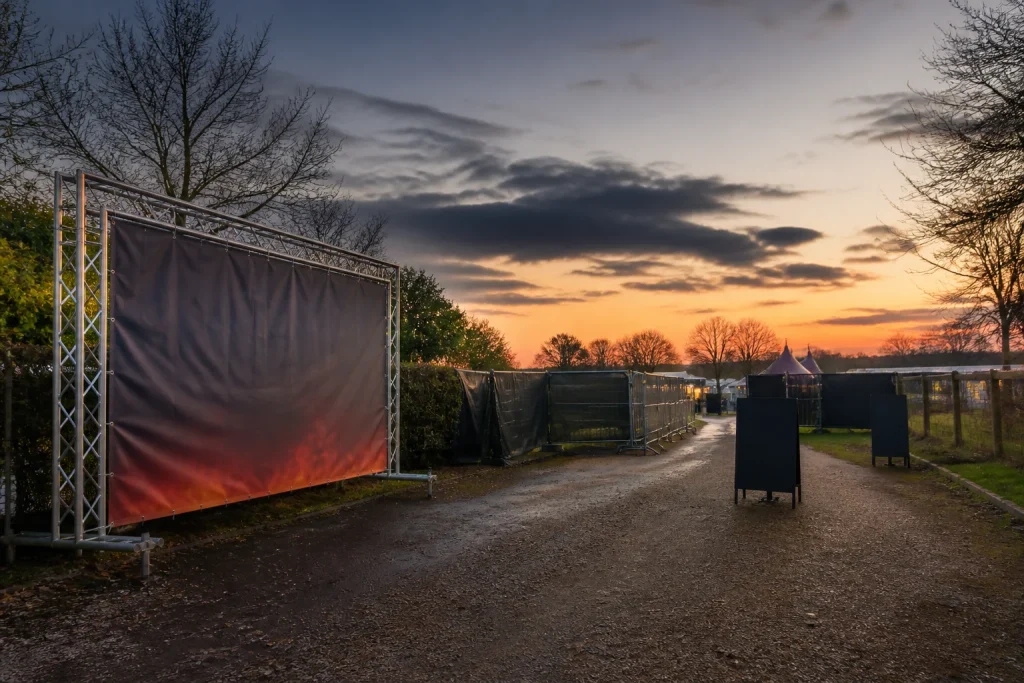
Banner placement is not simply a design decision. It should be agreed with the person responsible for the site, taking account of the venue layout, existing signs, access routes and conditions on the day. A display that is visible from one direction may be obscured from another.
Keep essential visitor information separate from anything that needs official approval or formal safety wording. Event organisers should confirm the current information, decide which instructions belong on permanent display and follow the venue’s procedures for siting and securing signage. A print supplier can produce the banner, but cannot assess a particular site or take responsibility for its installation.
It is worth making a placement list: banner purpose, intended location, viewing direction, fixing requirement and the person who will check it before gates open. Include a backup option if an agreed location becomes unavailable. This avoids last-minute improvisation, which is where a well-designed banner can end up facing the wrong way or hidden behind temporary equipment.
Common mistakes with large bonfire night banners
The common mistake is treating the available print area as space that must be filled. Large banners can carry big type, generous clear space and one confident message; they do not need to resemble a flyer enlarged to several times its normal size. A second mistake is adding event information before it has been confirmed. If timings, entry arrangements or a sponsor list may change, ask whether that content should appear on a more flexible supporting item instead.
Colour can cause trouble as well. A dark seasonal background may suit the occasion, but dark type on dark imagery can disappear. Likewise, bright effects behind pale lettering can make a headline look lively but difficult to read. Check contrast on the final proof rather than relying on the original artwork file.
Finally, do not assume a banner is the answer to every site need. A-frame signs, posters, boards or smaller directional displays may make more sense where visitors need close-up instructions, where routes divide, or where one large display cannot be positioned clearly. Choosing several focused signs can be more useful than forcing every message onto one format.
Conclusion
Large Bonfire Night banners should give visitors one clear message at the point they need it. Define the banner’s job, put the vital wording first, design for the real viewing distance and agree placement with the site team before printing. Newstyle Print provides wide-format print, including PVC banners and bespoke display work, and can help turn an organised brief into a high-quality printed display. Prepare the confirmed wording, intended location, finished size and artwork requirements before requesting a quote; if the layout still needs work, design support can be discussed as part of the project.