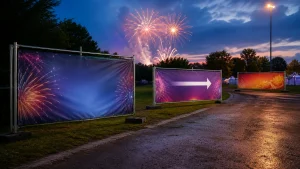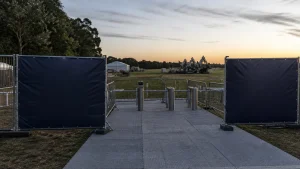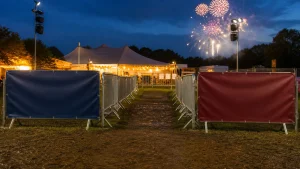
Fireworks event signage works best when it gives visitors one clear instruction at a time. At a busy display, safety information, directions and event promotion should not fight for the same visual space. Put essential safety messages on dedicated signs, then use separate displays for entrances, toilets, food, viewing areas and sponsor recognition. That division makes each message easier to review and easier for visitors to understand without decoding a crowded design.
⏱️ Estimated reading time: 6 minutes
Table of Contents
The starting point is not the sign material or the artwork. It is deciding what people need to know, where they will need to know it, and which messages must remain visible even when the site is busy. A well-planned sign system supports the event team’s own safety arrangements; it does not replace risk assessment, stewarding, announcements or any venue-specific procedures. Before printing, the organiser or designated safety lead should approve the wording, locations and final versions.
Fireworks event signage should give safety messages their own space

Safety signs have a different job from promotional displays. Their purpose is to communicate a required action, restriction or warning with as little distraction as possible. A sign saying “Keep behind the barrier” should not also try to sell refreshments, advertise a sponsor or carry a long programme of entertainment. Those additions may seem harmless, but they weaken the hierarchy of the message.
Keep the main instruction short and place it where visitors can see it before they reach the relevant point. Supporting detail can sit underneath if it is genuinely needed, but the action should be clear at a glance. Plain language is usually the better choice. “Use this entrance” is more immediate than a sentence explaining the arrival process, while “No access beyond this point” is clearer than an overly polite but vague notice.
Consistency matters as well. If one sign refers to the viewing area and another calls it the display zone, visitors may hesitate. Agree the names for entrances, exits, facilities, meeting points and restricted areas before design begins. Repeating those exact names across signs, maps, tickets and steward briefings reduces avoidable ambiguity.
Build a message map before choosing sign formats
A message map is a simple list of the information required at each part of the visitor journey. It prevents a common last-minute problem: ordering several attractive signs, then realising that nobody has covered the route from parking to the viewing area. Walk through the venue on paper first, from arrival to departure. It also helps staff answer routine questions consistently when visitors arrive.
| Location | Primary sign job | Keep separate |
|---|---|---|
| Approach and entrance | Confirm the correct arrival point | Detailed site rules and food offers |
| Queue or gate | Set out entry instructions | General event branding |
| Routes and junctions | Direct visitors towards facilities or viewing areas | Warnings unrelated to that route |
| Safety boundary | State the restriction or required action | Sponsor logos and programme details |
| Food or activity area | Identify the facility clearly | Critical safety instructions |
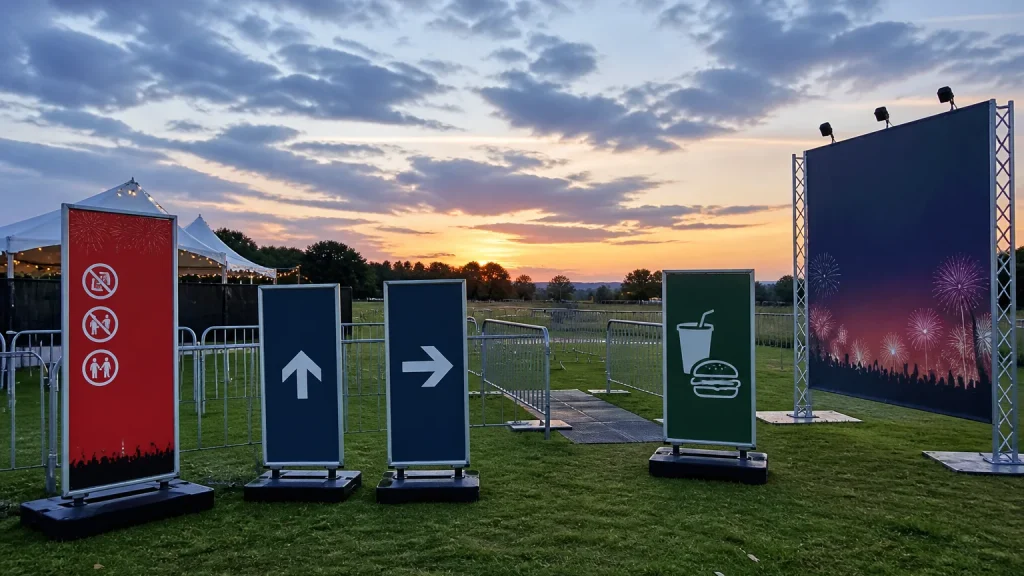
For a hypothetical community fireworks display, the first sign at the car park might simply direct visitors to the pedestrian entrance. A second sign near the gate can cover ticket or entry arrangements. Once inside, directional signs can lead to toilets, refreshments and the viewing area. Boundary signs then deal only with access restrictions. Each display has one job, which makes the whole site feel calmer even when attendance is high.
Fireworks event signage: choose formats by location
The right printed format depends on the message, available fixing points, viewing distance and whether the sign needs to move during the event. Newstyle Print offers PVC banners, roller banners, A-frames, Foamex boards, Correx boards, Dibond boards, custom-cut signs and self-adhesive vinyl. The practical choice should follow the event plan rather than a preference for one material.
For example, a large banner may suit a fixed entrance message where there is a clear place to display it. Rigid boards may be considered for individual directional or boundary messages where a self-supporting or mounted sign is planned. A-frames can be useful for temporary wayfinding on suitable level ground, although they need thoughtful placement so they do not obstruct a route. Ask the venue team what fixing, positioning and removal arrangements are permitted before finalising a specification.
Check sightlines before committing to sizes. Stand at the point where a visitor will first encounter the sign, then consider queues, parked vehicles, temporary barriers and low light. A message that is technically present but hidden by the event layout is not doing its job. This simple check may also reveal where duplicate directional signs are justified.
Artwork needs to match the setting. Avoid using a long paragraph, thin typefaces or several competing colours on a sign that will be read while people are walking. Use a clear heading, a concise instruction and high contrast between the wording and background. Where a symbol is used, pair it with plain written information rather than assuming every visitor will interpret it in the same way.
Common mistake: treating every sign as event promotion

Fireworks events naturally need a sense of occasion, and branded displays can help make the venue feel organised. Decorative fireworks graphics, dense sponsor rows and elaborate backgrounds may belong on a welcome display or photo area, but they can be unhelpful on a safety notice.
Another mistake is putting changing information onto every printed item. If gate arrangements, timings or facilities are still being confirmed, keep those details off large, permanent-style displays until they are approved. Consider which information is fixed, which may change and which is better handled through event communications or temporary notices. A final content check should compare every printed message with the approved event plan so old versions do not remain in use.
Conclusion
Effective fireworks event signage separates safety instructions from directions, facilities and promotional content. Start with a visitor journey, give each sign one clear purpose and choose formats only after the message and location are agreed. If your event needs a mix of wide-format displays, directional boards or bespoke printed signs, prepare a concise brief covering the approved wording, quantities, intended locations and artwork requirements before requesting a quote.