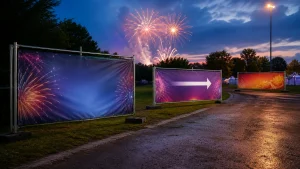
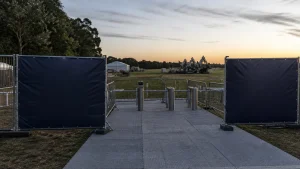
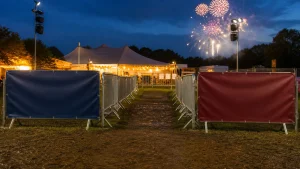
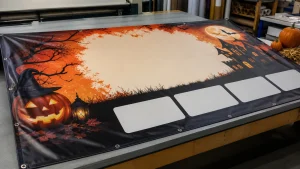
Custom Fireworks Night banners are easier to plan when every display belongs to a particular visitor zone. Instead of trying to fit directions, event identity, food offers, sponsor recognition and seasonal artwork onto one surface, divide the information according to where people will see it. That approach can make a busy event site feel more orderly without making every banner look the same.
⏱️ Estimated reading time: 6 minutes
Table of Contents
- Map custom Fireworks Night banners to visitor zones
- Choose one primary message for each display
- Create hierarchy in custom Fireworks Night banners
- Separate seasonal atmosphere from practical notices
- Plan the sequence, not just individual designs
- Select materials and finishing for the intended setting
- Prepare a clear brief for custom Fireworks Night banners
- Conclusion
A Fireworks Night event may need printed displays at the approach, entrance, activity areas and exit. Each location creates a different question for visitors. Someone arriving needs reassurance that they are in the right place; someone at a path junction needs a choice made clear; someone near a stall may simply need to see what is available. Planning around those moments gives the banner set a useful structure.
Map custom Fireworks Night banners to visitor zones

Begin with a simple site plan, even if it is only a sketch. Mark where people arrive, queue, enter, move between areas and leave. Then note the decision or message that matters at each point.
The outer edge of a venue might use event-name displays or branded welcome banners. The entrance zone may need a short arrival message, while interior routes can use destination-led displays. Food, attractions and fundraising areas may have their own promotional material.
Not every event needs all of these zones. A compact venue may need only an arrival display and a few directional messages. A larger field, park or grounds may call for more separate pieces.
Choose one primary message for each display
Once the zones are mapped, assign one main job to every banner. A welcome banner can identify the event. A directional banner can point towards a destination. A promotional banner can draw attention to a stall, activity or supporter. A practical information display can present wording supplied and approved by the organiser.
- Arrival displays: event name, host identity or a simple welcome.
- Wayfinding displays: a destination label and a clear arrow where appropriate.
- Area identifiers: food, viewing, first aid, toilets or another agreed location.
- Promotional displays: a stall, offer, activity, sponsor or seasonal feature.
Supporting content is possible, but it should not overtake the main message. For instance, a banner reading “Food This Way” may carry a small event logo. Turning it into a general poster with a schedule, several logos and a large firework illustration would weaken its directional role. If several messages genuinely matter, they are usually better separated across nearby displays.
Create hierarchy in custom Fireworks Night banners
Hierarchy is the order in which a reader notices information. On a banner, the most useful words should generally be the easiest to spot.
Use short labels where possible. “Main Entrance”, “Food”, “Tickets” and “Viewing Area” are easier to scan than explanatory sentences. Arrows also need enough surrounding space to remain obvious.
Contrast matters, although there is no single colour combination that suits every event or location. Dark, firework-inspired artwork can set an appropriate mood, but the message still needs to stand apart from it.
Separate seasonal atmosphere from practical notices
Firework bursts, night-sky colours and celebratory wording are well suited to welcome points, photo areas and promotional displays. They can help create a joined-up event identity.
Keeping those purposes apart gives the design more room to work. A food-area banner can be visual and playful, while an area identifier can use plainer language and open space. Repeating a logo, typeface or limited group of brand colours can still make the collection feel connected. Consistency does not mean copying one layout onto every banner.
Take care with details that may change during planning. Unconfirmed timings, prices, entry arrangements or programme information can become inaccurate before print approval. It may be more sensible to keep reusable event branding separate from changeable information.
Plan the sequence, not just individual designs
Visitors see banners in an order, so consider how one message leads to the next. An approach banner might establish the event identity. The next display can confirm the entrance, followed by a directional sign at a route split. Further inside, a separate display may identify refreshments or an activity area. Repeating the same information everywhere is unlikely to add much value.
Imagine a hypothetical community event on a school field. A branded banner at the gate welcomes attendees. Matching directional banners guide them when paths divide, and a separate food-stall banner promotes the available refreshments.
Consider sightlines as well. A display can only help if it is placed where people can reasonably notice it before making a decision. Obstacles, queues, lighting, crowd movement and the final mounting position may affect what works.
Select materials and finishing for the intended setting

Banners, posters and rigid signs are related display products, but they are not interchangeable. A poster may suit close-range reading, whereas a banner may be chosen for a larger promotional or directional display.
Newstyle Print offers PVC banners alongside other wide-format display products, including boards and roller banners. The right choice should be confirmed for the individual brief. Do not assume that one material, size or fixing arrangement suits every venue, particularly where the display will be positioned outdoors or in an exposed area. Share the intended location and mounting plan before production so the specification can be discussed properly.
Prepare a clear brief for custom Fireworks Night banners
A well-organised brief helps keep a coordinated set of banners distinct. For every item, include its purpose, proposed finished size, quantity, display location, main message, artwork status and any deadline that affects the order.
Provide approved logos, brand colours and final copy together if the banners need to match flyers, posters, menus or other printed event material. If artwork is still being developed, identify what remains undecided before requesting production.
Conclusion
Custom Fireworks Night banners work best as a planned sequence of displays, not as repeated versions of one crowded design. Map visitor zones, give each banner a primary message and reserve themed artwork for places where it supports rather than distracts from the purpose. A complete brief covering content, location, artwork and intended use makes it easier to develop a coordinated wide-format print requirement.